Last verified: September 14, 2026.
What a Main Line stone-house owner is actually dealing with
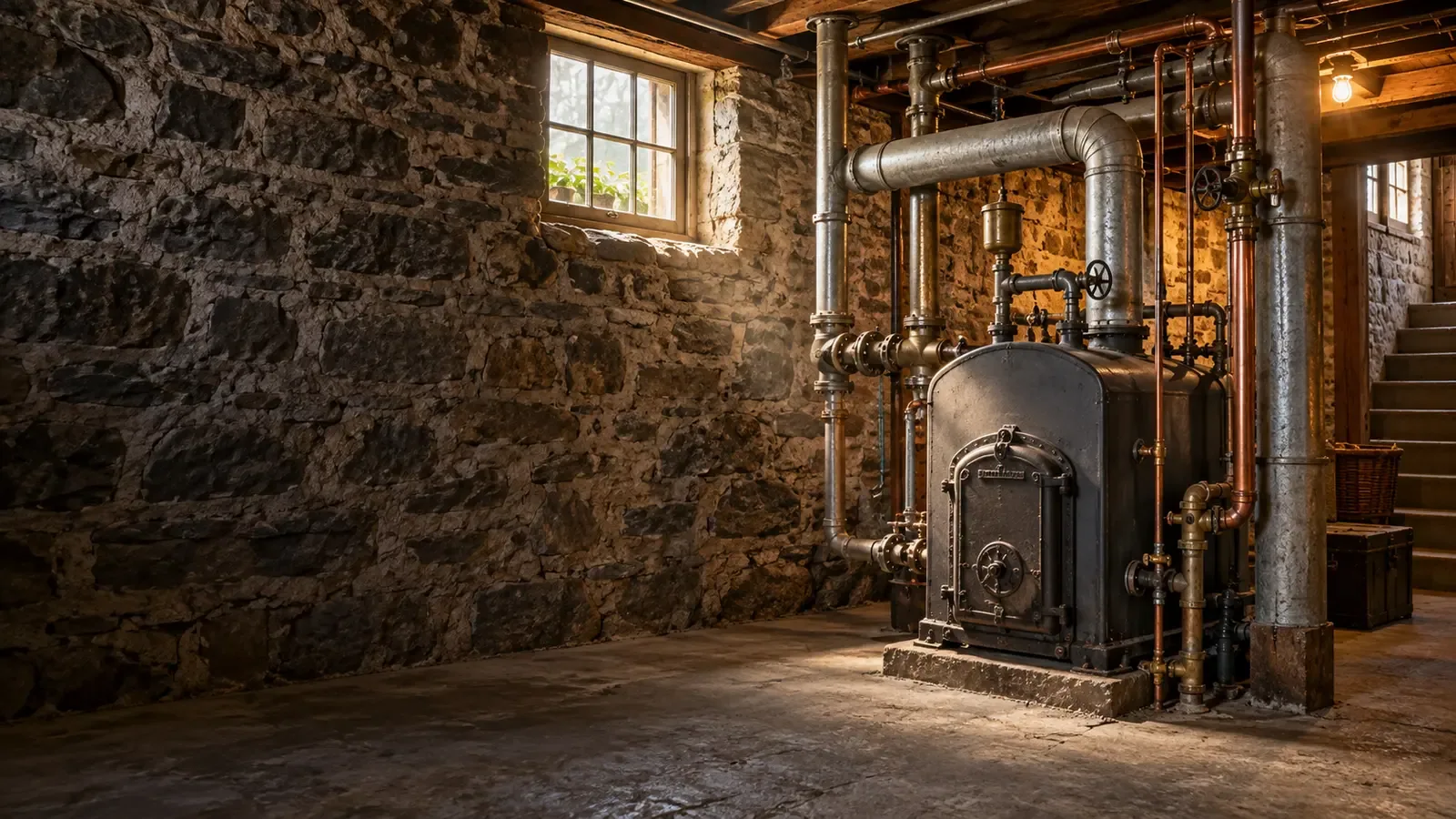
If you own a stone or masonry house on the Pennsylvania Main Line — Lower Merion, Gladwyne, Villanova, Haverford, or Bryn Mawr — built roughly between 1890 and 1930, your plumbing and heating systems are likely a mix of original work, partial updates, and whatever the previous owners finished. Three issues show up again and again in houses of this vintage, in this corridor: original or partially replaced water service lines that may still contain lead or older galvanized steel; one-pipe steam heat that has often been serviced piecemeal for decades; and a kitchen, bath, or servant-wing addition whose piping nobody has looked at closely since the original work.
These are not exotic problems. They are the predictable legacy of an era when the house was built for one family’s habits and has since been carved into different uses, owners, and renovations. The right framing is not “what’s wrong with my house” but “what is original, what has been touched, and what hasn’t.” A good answer to that question usually has to come from someone who crawls under the floor and looks at the pipe.
A few limits are worth stating up front. This guide does not name any plumber, contractor, or utility, and it does not assert that your specific house has any of these systems. It also does not assume that every Main Line stone house from this era still has its original water service or its original heating system. Many have been partially or fully replaced. The article describes what to check for and how to read the answer, not a verdict on any single property.
Why this era of house produces these specific problems
The Main Line townships grew rapidly between 1890 and 1930 as Philadelphia’s professional class moved outward along the Pennsylvania Railroad. Lower Merion became a first-class township in 1900, and the surrounding villages — Gladwyne, Bryn Mawr, Haverford, Villanova, Wynnewood — filled in with substantial stone and masonry houses set on former estate land [1]. Those houses were plumbed for the standards of their day: lead or galvanized-iron service lines from the street to the house, large vertical runs to upper floors, and boiler-fed steam heat piped through walls and ceilings in patterns that followed the original room layout rather than any modern logic.
Three things have changed since the original build. First, drinking-water science caught up with the problem of lead service lines, and federal rules now require every community water system to inventory its service lines and flag the ones that are lead, galvanized-requiring-replacement, or unknown [2][3]. Second, steam heating fell out of fashion for new construction after mid-century, so working trade knowledge of one-pipe steam now sits with a smaller group of technicians than it did in the 1940s [4]. Third, additions and renovations typically followed the path of least resistance: new fixtures tapped into the nearest existing pipe, and servant wings, attic baths, and basement additions got the work the original plumbing was never sized for.
You cannot read any of this off the exterior. The same stone facade can hide three different generations of pipe behind the plaster, and that is the working assumption for everything below.
What a qualified plumber should verify on the water side
The first conversation to have is about your service line — the pipe that runs from the street (or curb stop) to your house. Under the federal Lead and Copper Rule Revisions and the newer Lead and Copper Rule Improvements, every community water system in Pennsylvania has been required to prepare a service line inventory, with initial inventories due to PA DEP by October 16, 2024 and a baseline inventory due by November 1, 2027 [2][3]. Pennsylvania systems must also notify customers whose service line is lead, galvanized-requiring-replacement, or of unknown material, and repeat that notice annually [2].
What to ask, and what a useful answer sounds like:
- Whether your water utility has published its service line inventory, and what it shows for your address. A useful answer is the specific material classification: lead, galvanized-requiring-replacement, galvanized-not-requiring-replacement, copper, plastic, or unknown.
- If your service line is classified as unknown, what verification the utility has done or will do, and what you can do to confirm the material on your side of the curb stop. A useful answer names a verification method (visual at the meter or entry point, scratch test, or planned excavation) and an expected timeline.
- Whether any portion of the service line on the property side is your responsibility. Ownership boundaries vary by water provider, tariff, meter location, and property. A useful answer confirms the boundary for your address in writing.
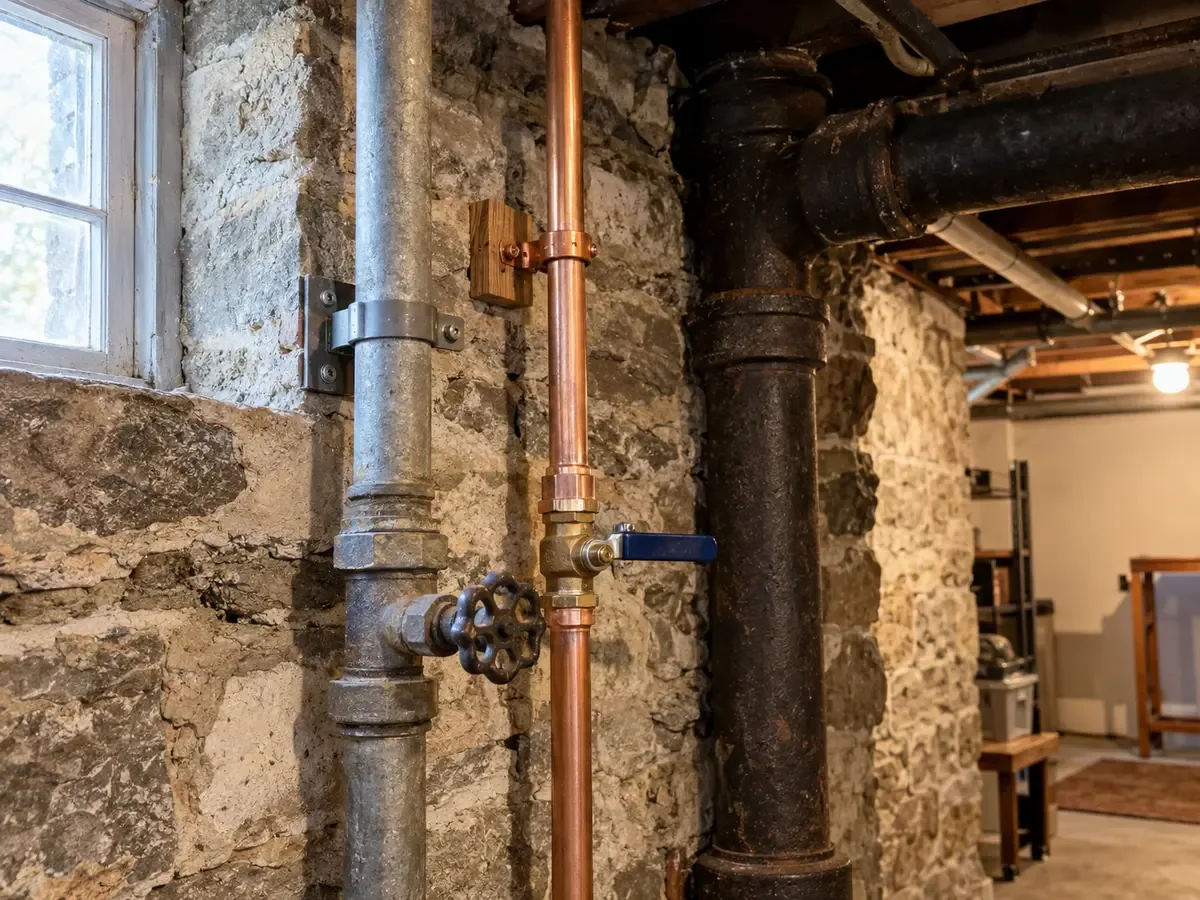
- Whether the plumber will assess the interior distribution (the piping inside the house) separately from the service line. Older interior piping, solder, brass, and later transitions can present different questions even when the buried service line is modern.
What the plumber should not do without a clear, sourced reason: recommend a full re-pipe, a partial replacement of just the service line, or any “no-lead” certification without first establishing the actual material of both the service line and the interior distribution.
What a qualified plumber should verify on the heat side
If your house still runs on steam, the system is most likely either a one-pipe or a two-pipe steam system installed in the early twentieth century. In a one-pipe system, a single pipe carries steam out from the boiler to each radiator and returns the condensed water back to the boiler through the same pipe at the same time, with small vents releasing trapped air so steam can travel [4]. Two-pipe systems separate the supply and return paths. Either type is technically sound, but both were designed for coal-era boilers and the radiators, vents, and piping that were original to the house.
Common problems in steam systems of this age, as documented in government technical primers, include noisy pipes, leaking radiator valves, and uneven heating across rooms — radiators near the boiler getting too hot while distant radiators stay cool [4]. The primer-level maintenance is also well established: annual burner tuning, periodic inspection of air vents, and routine cleaning of the boiler water to manage scale and corrosion [4].
What to ask:
- Whether the system is one-pipe or two-pipe steam, and whether that matches the radiator and piping configuration in the basement.
- When the boiler was last serviced, when the air vents were last checked or replaced, and whether the water-level controls have been tested.
- Whether any radiators have been added, removed, or capped off — a capped-off radiator in a one-pipe system can disrupt the whole loop.
- Whether the boiler itself is original equipment or has been replaced, and at what point in its life the controls and safety valves were last inspected.
A useful answer names specific components and specific conditions; a vague answer (“your steam system needs work”) without a component-by-component read is a signal to ask for the breakdown.
Trade-offs between partial repair, staged work, and full replacement
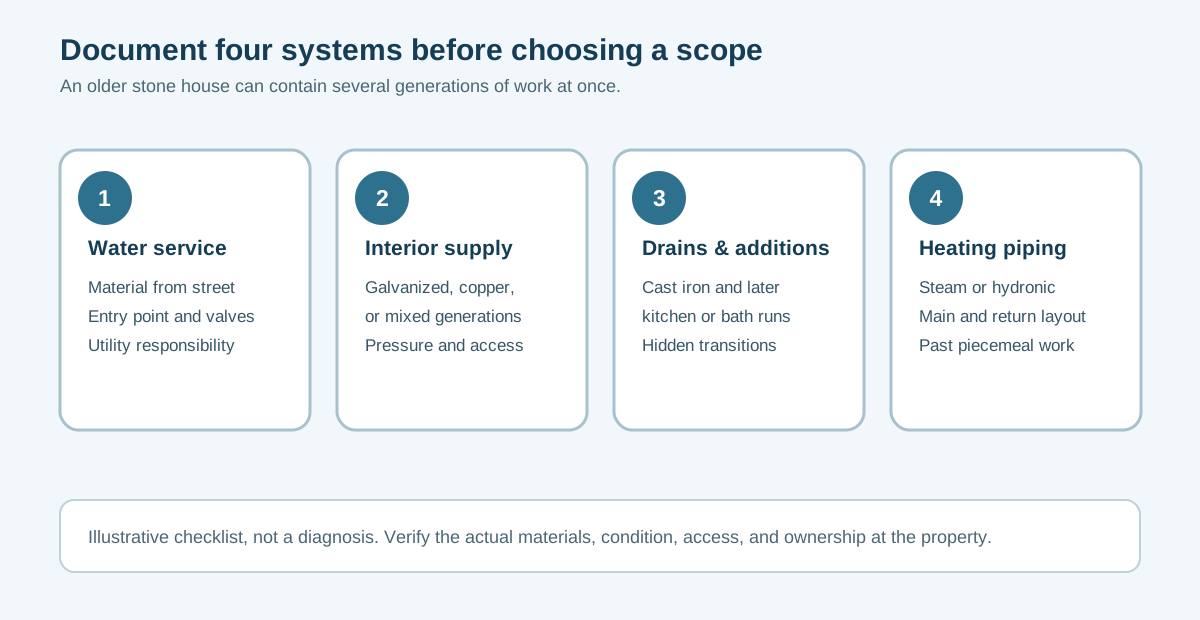
Three broad approaches show up on proposals for Main Line stone houses of this era, and the right one depends on what the diagnostic step actually finds.
Targeted repair. If the diagnostic finds one failed section — a leaking radiator valve, a cracked supply pipe, a single bad air vent — a targeted repair is usually appropriate. Steam systems in particular often run for decades between larger interventions if the components are maintained [4]. The trade-off is that you are paying for a plumber who knows this specific system, not just generic residential plumbing.
Staged modernization. If the diagnostic finds original or partially replaced service lines and an aging but functional steam system, many homeowners stage the work: address the service line first (because it carries the direct health implication under the federal lead rule), then plan the heating work over one or two heating seasons. The trade-off is scheduling around weather and the possibility of two separate contractors if no single firm handles both water service and steam.
Full-system replacement. This is sometimes right when the original piping has been patched in many places and the boiler is at the end of its service life. The trade-off is cost, disruption to finished walls and floors, and the loss of original fabric in a house whose stone exterior is part of why you bought it. There is no honest way to compare these paths on price without a specific property, a specific diagnostic, and current contractor proposals; any source that quotes you a number for “re-piping a Main Line stone house” is guessing.
How to read a plumber’s answer
A grounded answer names the specific component being discussed — the service line material at the curb stop, the vent on the third-floor radiator, the boiler’s low-water cutoff — and connects it to a condition that was checked or a test that was performed. A generic answer uses phrases like “your whole system” or “everything in these old houses” without anchoring to a measurement or an observation.
A grounded answer is also honest about uncertainty. Pennsylvania does not issue a statewide plumber license; the trade is regulated locally, and applicable registrations vary by municipality. A qualified plumber working in Lower Merion should be able to tell you, in plain language, which local registrations and consumer protections apply to your job. If a contractor is vague about registration or insurance, treat that as a separate question to resolve before signing anything.
Two more signals worth watching for: whether the plumber will put the diagnostic findings and the proposed scope in writing, and whether they are willing to explain, in plain terms, what would happen if you deferred nonurgent work for a season. Deferral may be reasonable for a noisy but functional radiator after a qualified inspection; it is not an appropriate assumption for an active leak, a service line classified as lead, or a boiler failing its safety controls. A plumber who will only sell the most expensive option is not necessarily wrong about that option being necessary — but they are not yet your best source for confirming it.
Where the homeowner’s responsibility stops and the utility’s starts
The boundary that catches many Main Line homeowners off guard is often near the curb stop, meter, or property line—but the exact ownership boundary is provider- and property-specific. That is one reason the federal service line inventory matters: it identifies both utility- and customer-side materials where information is available, while replacement responsibilities and access must be confirmed with the serving water provider [2][3].
For heating, the boundary is different. A steam system is almost entirely on the home side of the meter, which means the diagnostic and maintenance responsibility is yours to schedule, even if some of the components (the boiler, in particular) may be subject to inspection or permitting under local mechanical codes.
Safety boundaries worth keeping in mind without trying to do the work yourself: do not attempt to drain or refill a steam boiler without knowing the procedure for that specific boiler, because a dry-fire can damage the cast iron sections; do not attempt to expose or cut into a suspected lead service line without proper containment, because disturbance can release lead particulates; and do not ignore the smell of gas, the sound of water where it shouldn’t be, or a boiler that is not firing reliably — those are reasons to call a qualified technician the same day, not the next week.
If you have a water emergency (main break, basement flooding from a failed service line) call your township’s public works or your water utility directly. If you have a gas or carbon-monoxide concern, leave the house and call your gas utility’s 24-hour line or 911. The rest of this guide is for planned work, not emergencies.
Sources
- Lower Merion Historical Society. “Overview of Lower Merion Township.” https://collections.lowermerionhistory.org/lower-merion
- Pennsylvania Department of Environmental Protection. “Lead and Copper Rule.” https://www.pa.gov/agencies/dep/programs-and-services/water/bureau-of-safe-drinking-water/drinking-water-management/drinking-water-regulations/lead-and-copper-rule
- U.S. Environmental Protection Agency. “Planning and Developing a Service Line Inventory.” https://www.epa.gov/ground-water-and-drinking-water/planning-and-developing-service-line-inventory
- NYC Mayor’s Office of Climate and Sustainability / NYC Accelerator. “Tech Primer: One-Pipe Steam Systems.” https://www.nyc.gov/assets/nycaccelerator/downloads/pdf/hprt-techprimer-1pipe-steam.pdf
Note on PA contractor registration: Pennsylvania does not issue a statewide plumber license, and applicable contractor registration in this article is described in general terms. Readers should confirm current applicability with the PA Attorney General’s Bureau of Consumer Protection or with Lower Merion Township code enforcement before hiring.