Last verified: September 15, 2026.
Short answer: yes, replacing a residential water heater in Montgomery County requires a Pennsylvania Uniform Construction Code (UCC) permit — but which office actually issues the permit depends on which township or borough the home sits in, and that answer changes at the municipal boundary. The work itself is regulated statewide; the paperwork route is local.
This guide is not a how-to for replacing a water heater. Disconnecting and reconnecting a gas line, fuel-gas venting, combustion-air supply, or a 240-volt circuit is not a homeowner-friendly repair and should be handled by a qualified tradesperson. The directory does not recommend, rank, or endorse any plumber.
Where the Permit Trigger Comes From — and Why It Splits by Municipality
Pennsylvania’s UCC applies statewide to residential plumbing, mechanical, and gas work, including the replacement of a regulated water heater. The Pennsylvania Department of Labor & Industry explains the framework the same way on its UCC landing page: “over 90% of Pennsylvania’s 2,562 municipalities have elected to administer and enforce the UCC locally, using their own employees or via certified third party agencies (private code enforcement agencies) that they have retained.” [^1] Where a municipality has not elected to administer the UCC, the Department itself handles commercial code enforcement, and “certified third party agencies hired by property owners (or their contractors) enforce the residential requirements of the UCC in all opt-out municipalities.” [^1]
That single sentence is the entire reason a homeowner in one Montco township can ask a different office for a permit than a homeowner in a neighboring borough. The state writes the rules; each municipality decides who runs the counter. A municipality can change its election, which means any snapshot of “the rule for this township” or “the rule for that borough” is by definition a point-in-time answer, and the homeowner should re-check at the time of the actual project.
The current code cycle is the 2018 International Code family as reviewed and amended by PA’s Review and Advisory Council, with the regulations “effective February 14, 2022” and a 2025 UCC Triennial Update with “an effective date of January 1, 2026.” [^1] Lower Merion Township, in a notice posted to its own permits page, restates the same adoption date for residential work in town: “On February 14, 2022, new Uniform Construction Codes will go into effect throughout the state of Pennsylvania,” and “Beginning August 13, 2022, all permit applications submitted for new buildings or major renovations must be reviewed under the 2018 I-codes.” [^2]
How a Single Montco Township Actually Runs the Process
The cleanest picture of “the municipality administers the UCC itself” in Montgomery County is the Lower Merion Township Building Regulations Division. Lower Merion runs an online permitting portal that accepts residential applications — including plumbing permits — and collects fees for its own Building Review, rather than passing the file to PA DLI. [^2] The township’s permits-and-licensing page also flags a small, fixed statewide surcharge that every Montco permit applicant will see: “in addition to any Permit Fee, there is a $4.50 Pennsylvania State Training Fee collected on all building permits.” [^2]
That fee is the only number this article can quote with confidence: it is the line the township prints on every permit receipt, not an estimate. The actual permit fee — what the township charges for a residential plumbing permit review on top of the state surcharge — varies by municipality and is set by each municipality’s adopted fee schedule. Some Montco municipalities publish their own schedules; others route the residential review to a contracted certified third-party agency and quote that agency’s fee schedule instead. There is no single “Montco plumbing permit fee” to memorize.
For homeowners whose municipality has not elected to administer the UCC, the building code official is the PA Department of Labor & Industry. The application package, the fee schedule, and the inspector assignment all sit on the DLI side, not the township side. The directory does not enumerate which Montco municipalities are in which column — the PA DLI publishes that list and the article will not invent a row of the table.
What a Plumber Should Confirm Before Pulling the Old Tank
A residential water-heater swap implicates more than one trade, and a competent plumber should be able to walk through the specifics before quoting the work, not after.
A useful first visit typically covers:
- The fuel type and vent type. Gas, electric, and heat-pump water heaters pull different permit scopes. A gas unit implicates the fuel-gas code plus a mechanical review; an electric unit typically pulls a plumbing and an electrical review; a heat-pump unit adds condensate drainage. A plumber who cannot name the codes that apply to the specific unit they are about to swap is not the right fit for the job.
- The replacement unit’s listing and clearances. Direct-vent, power-vent, atmospheric, and heat-pump water heaters have different combustion-air, venting, and clearance requirements under the 2018 International Mechanical Code and International Fuel Gas Code as adopted into the PA UCC. The replacement must be listed for the installation configuration the home actually has.
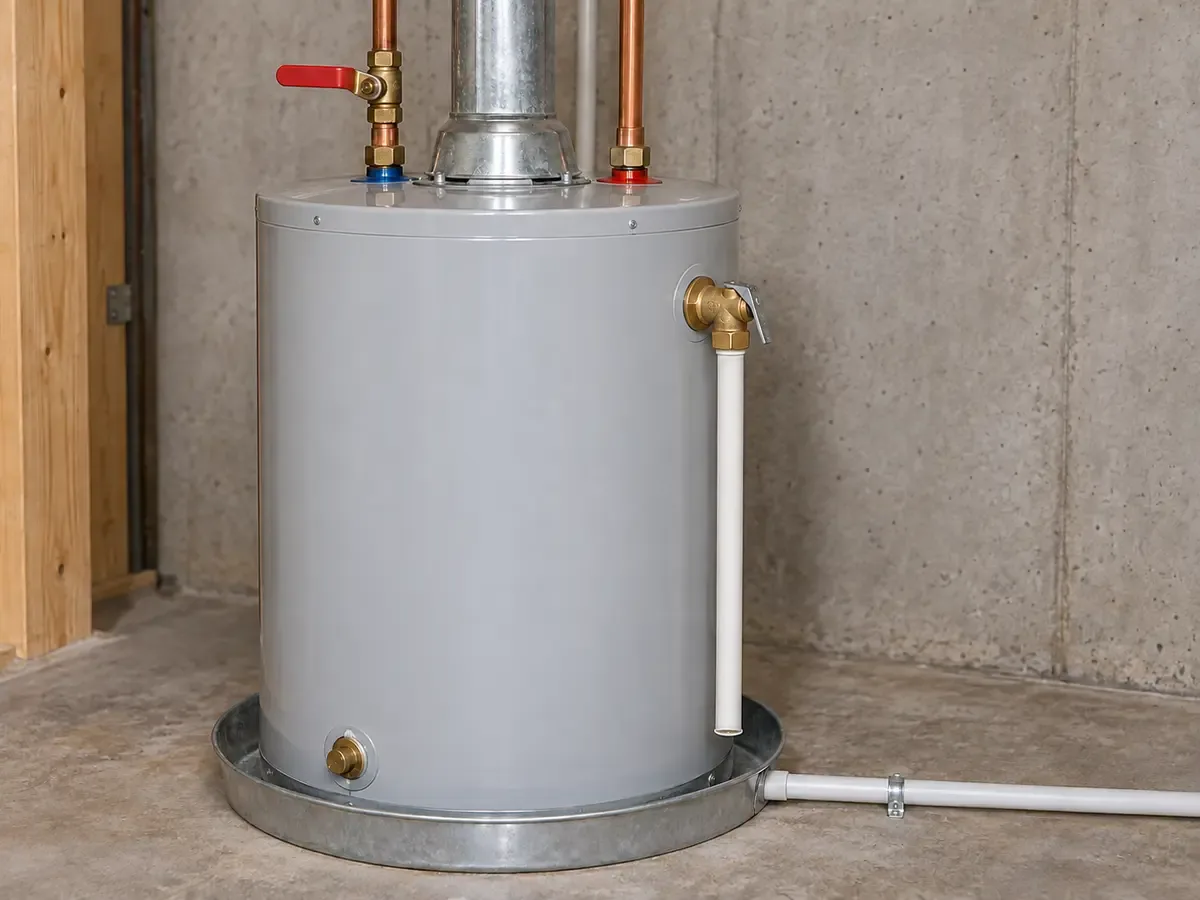
- Existing pan, drain, and strapping. Existing code-required pan, drain routing, and (where applicable) seismic strapping often need to be re-evaluated when a unit is replaced. The plumber should describe how the new installation will meet current code, not just mirror the old one.
- The permit path for the specific address. The plumber should know whether the permit goes through the local township/borough code department (the typical case for a self-administering Montco municipality), through PA DLI (for an opted-out municipality), or through a certified third-party agency hired by the property owner. That determines which office issues the permit, which inspector signs off, and what the fee actually is.
- The final inspection. A UCC permit is not complete until a final inspection. The plumber should return for it and should not consider the job closed until it passes.
A plumber who treats the permit as optional, or who says “we don’t pull permits for swaps,” is telling the homeowner that they intend to skip the inspection step the UCC requires.
Three Permit Paths a Montco Homeowner Can Land In
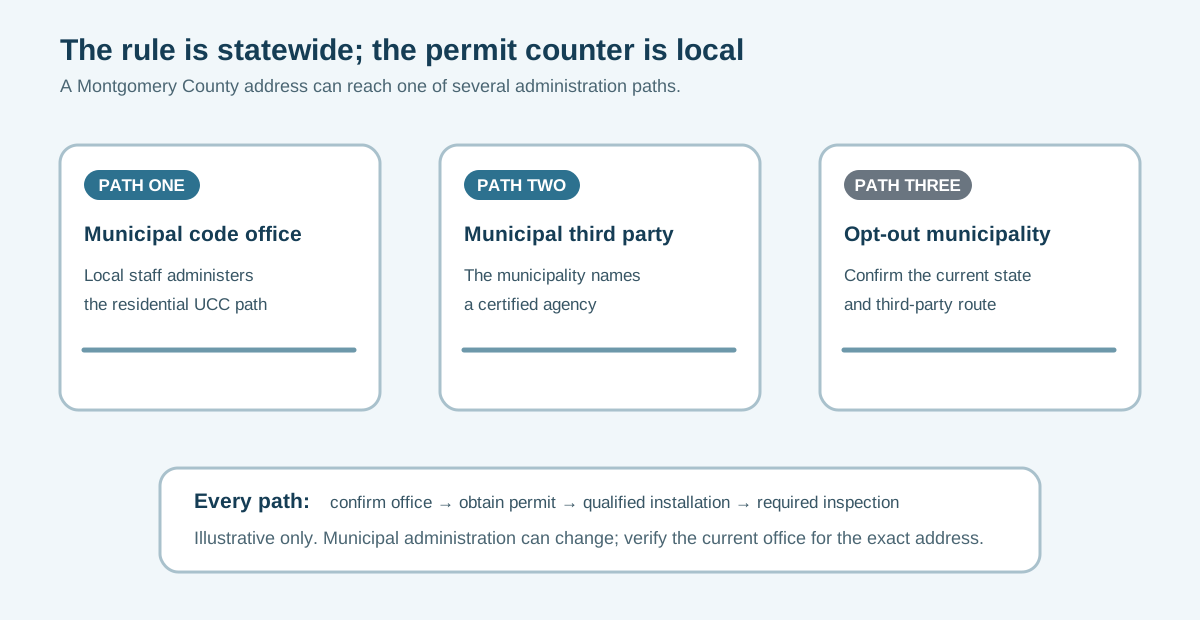
For a Montgomery County homeowner, the practical decision tree comes down to which of three offices answers the phone.
- Path A — The township or borough code department. This is the path for municipalities that administer the UCC locally (the majority case across PA per the PA DLI’s 90% statement). [^1] Lower Merion is the worked example verified here. [^2] Look for a “Code Enforcement,” “Building Permits,” “Building & Plumbing Codes,” or “Building Regulations” page on the township or borough website; if it exists and posts its own permit forms, that department is the building code official for that address. Fees, forms, and the surcharge line vary by municipality.
- Path B — The PA Department of Labor & Industry. This is the path for any Montco municipality that has not elected to administer the UCC. The application package, the fee schedule, and the inspector work for the Commonwealth. The PA DLI portal and landing page describe the package. [^1] The homeowner — or, more commonly, the contractor — files directly with the state.
- Path C — A certified third-party agency hired for the project. This is the residential path inside any opt-out municipality. PA DLI’s UCC landing page describes the structure: “certified third party agencies hired by property owners (or their contractors) enforce the residential requirements of the UCC in all opt-out municipalities.” [^1] In that case, the agency, not the township, is acting as the building code official for the project. The agency publishes its own fee schedule.
The narrow exception that crosses all three paths is the UCC’s three-business-day emergency carve-out. A failed water heater on a Friday evening can be replaced over the weekend, but a UCC permit application has to be on file with the appropriate code official by the following Wednesday (or the next business day after a holiday). The replacement still has to meet code; only the timing of the application is relaxed. The carve-out does not waive the inspection, does not waive the fee, and does not define what counts as an “emergency” — that determination belongs to the building code official, not the homeowner or the plumber.
A separate state regime applies to very large residential-style water heaters. The PA Department of Labor & Industry’s Boiler Division, under the Boiler and Unfired Pressure Vessel Law, oversees installation, relocation, and routine inspection of boilers and unfired pressure vessels, with enforcement “managed by the Department’s Boiler Division staff or, alternatively, by commissioned insurance inspectors.” [^3] A separate threshold applies to those units: water heaters over 120 gallons or 200,000 BTU input fall into the Boiler Division’s regime, not the standard UCC plumbing-permit framework. [^3] Most home water heaters (30–80 gallons, well under 200,000 BTU) are not in that category.
Questions That Reveal Whether the Plumber Actually Knows Montco
The point of asking is to confirm the plumber has done permitted water-heater work in the homeowner’s specific township or borough, not to quiz them. Useful answers tend to be specific.
- “Who is the building code official for my address — the township, PA DLI, or a third-party agency?” A useful answer identifies which one and what changes about the paperwork if it is one of the others.
- “Which permits will you pull for a like-for-like gas water heater swap — plumbing, mechanical, gas?” A useful answer names them and ties each to the work being done.
- “Will you file the three-business-day emergency application if the old tank fails?” A useful answer is yes, with a name or portal account that will be used.
- “Will you be on site for the final inspection, or do I need to be?” A useful answer explains how the inspection is scheduled and who needs to be present.
- “If my home is in a historic district or HARB area, does this swap trigger any additional review?” A useful answer acknowledges the question and explains how to check.
Pennsylvania does not have a single statewide plumber license. The credentialing that controls water-heater work depends on what is being done and where:
- PA UCC permit. Required statewide, including in Montgomery County, for replacing a regulated mechanical, gas, or plumbing system. The permit applicant files with the building code official (the township/borough, PA DLI, or a certified third-party agency, depending on local election).
- PA HIC registration. The Pennsylvania Home Improvement Consumer Protection Act requires most paid home-improvement contractors to register with the PA Office of Attorney General. HIC registration is not a plumber license, but it is the consumer-protection credential that covers most paid water-heater swap work. Verify any contractor’s current HIC registration before signing.
- Local plumber or contractor registration. Some Montgomery County municipalities require an additional local registration. If a given municipality does, the contractor must hold it before pulling the permit. Confirm directly with the township or borough.
Hard Limits and When to Call a Different Specialist
A few hard boundaries for any homeowner in this situation:
- Do not skip the permit. An unpermitted water-heater swap is a common discovery at resale and at insurance-claim time, and it is a code violation. The three-business-day emergency window exists precisely so a real emergency does not become an excuse for an unpermitted installation.
- Do not light a gas water heater yourself to “test” the new installation. Gas leak testing, combustion analysis, and vent-draft verification are not homeowner tasks. Leave the lighting and the first-run checks to the installing plumber and the inspector.
- If you smell gas, leave the home and call your gas utility from outside. A gas leak is a utility-and-safety issue, not a permit-timing issue.
- If the old water heater is leaking actively, shut off the water supply to the heater and, for a gas unit, the gas supply valve at the unit. Photograph the failure for the permit application. Do not delay the permit application past the three-business-day window.
- If the home is in a historic district, check before scheduling the work. Some HARB ordinances require a review before exterior utility changes (most often because the vent termination moves on the exterior). The plumber should know, but the homeowner should also confirm.
- Keep the closed permit, the contractor’s HIC registration verification, and the final inspection record. Together, these are the proof that the swap was permitted and inspected.
The directory is an independent information resource, not a plumbing company. It does not diagnose, install, or warrant any specific water heater, and it does not endorse any contractor.
Sources
- Uniform Construction Code (landing page) — PA Department of Labor & Industry — government source confirming the framework for local UCC administration (over 90% of PA municipalities administer locally via own employees or certified third-party agencies; opt-out municipalities route commercial enforcement to PA DLI and residential enforcement to third-party agencies hired by property owners), the 2018 I-Codes effective date of February 14, 2022, and the 2025 UCC Triennial Update effective January 1, 2026. Retrieved 2026-09-15.
- Permits & Licensing — Building Regulations Division, Lower Merion Township — primary local-government source for one Montgomery County municipality’s actual UCC administration. Confirms that Lower Merion runs its own Building Regulations Division, processes residential plumbing permits locally rather than routing them to PA DLI, applies the 2018 International Code family effective February 14, 2022, and collects a $4.50 Pennsylvania State Training Fee on every building permit. Retrieved 2026-09-15.
- Boilers and Unfired Pressure Vessels — PA Department of Labor & Industry — government source for the separate Boiler and Unfired Pressure Vessel Law administered by PA DLI’s Boiler Division. Confirms that the Boiler Division (or commissioned insurance inspectors acting on its behalf) approves installation or relocation of boilers and unfired pressure vessels, performs routine inspections, and certifies inspectors; the 120-gallon / 200,000 BTU threshold (from the search snippet attributed to this page) places large residential-style water heaters into this separate regime. Retrieved 2026-09-15.