Last verified: September 29, 2026.
Montgomery County does not have one countywide point-of-sale sewer-lateral rule. The current municipal rule that this guide can directly verify is Lower Pottsgrove Township’s; other towns may use a general resale inspection or a different local process. That is why a homeowner who is about to list or buy should confirm the rule with the municipality instead of assuming a neighboring township’s practice applies.
What a point-of-sale sewer-lateral inspection actually covers
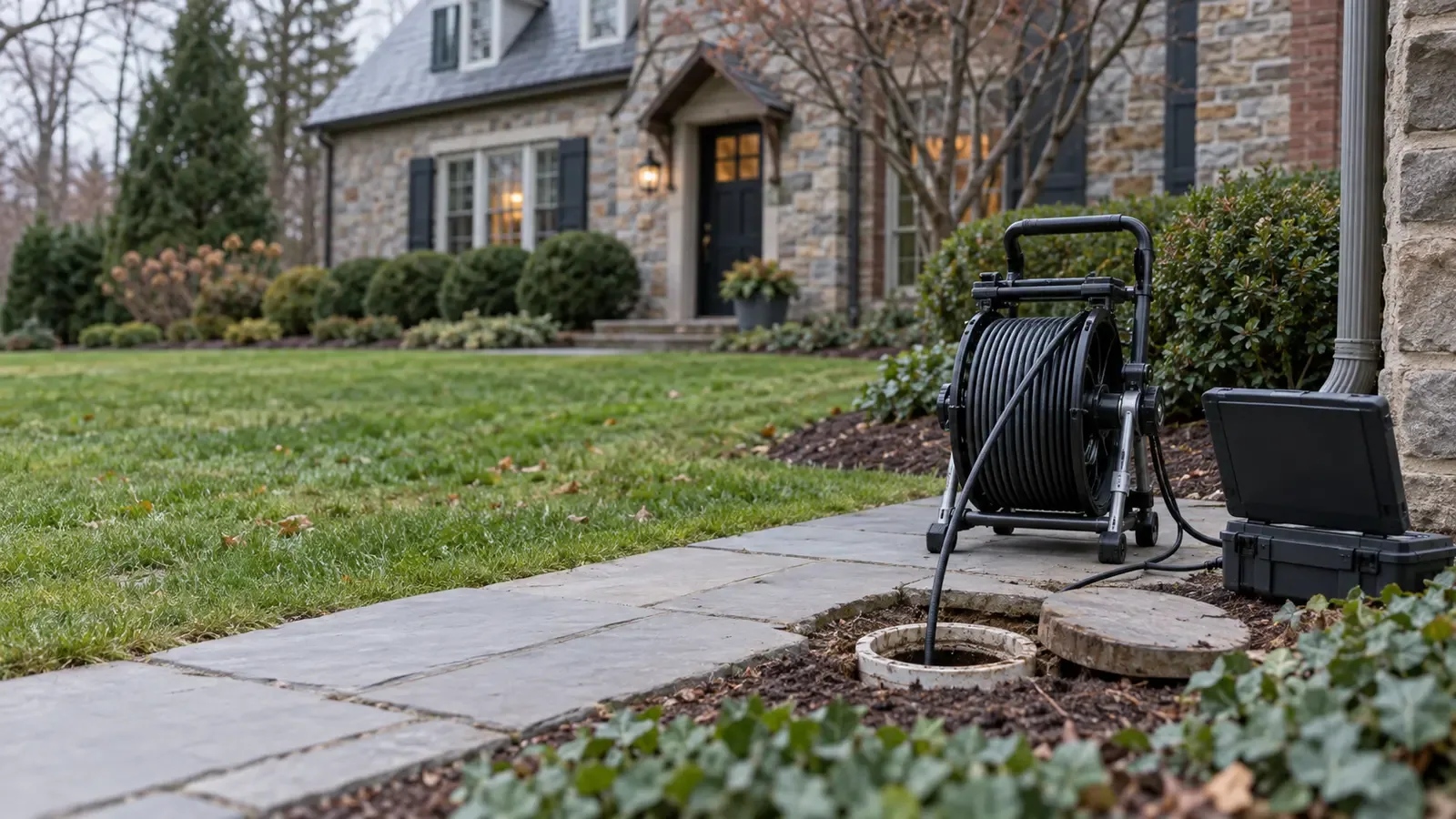
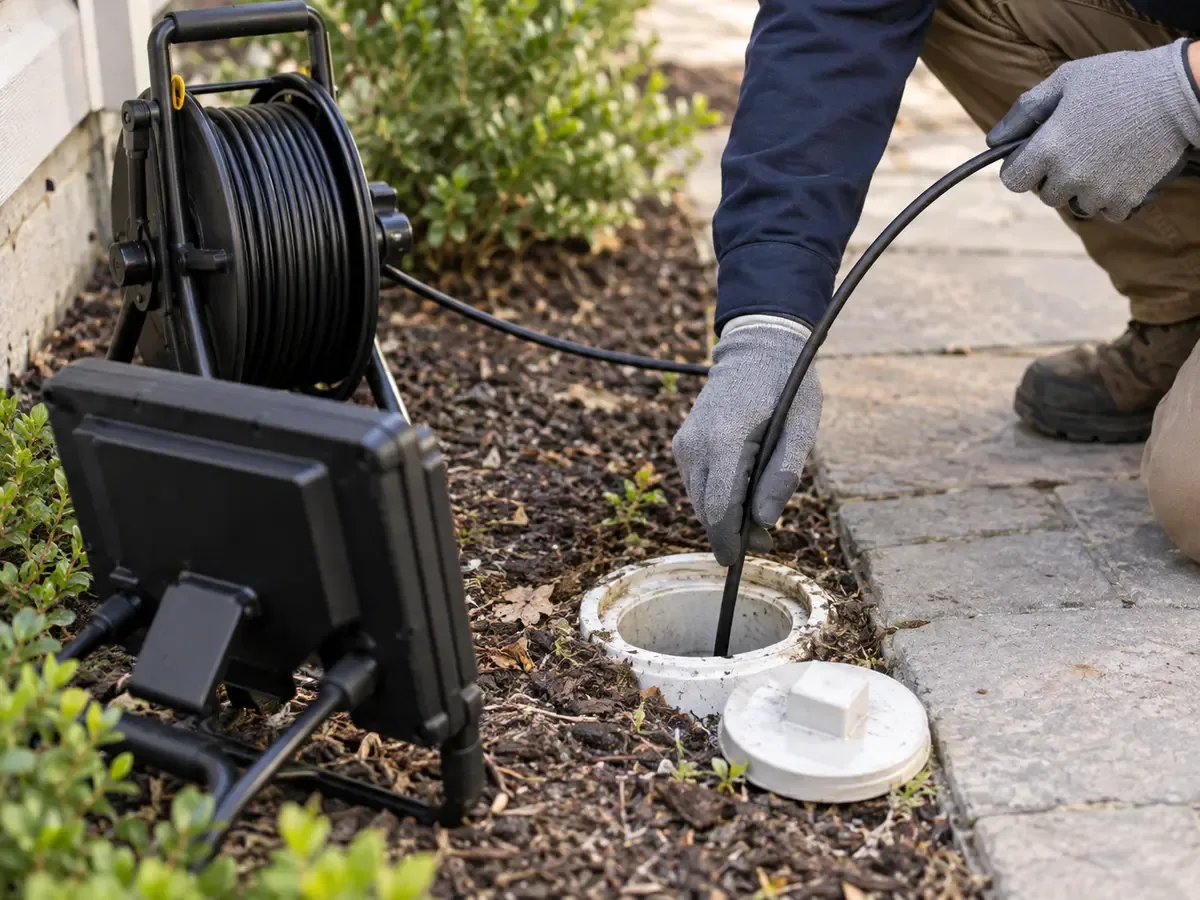
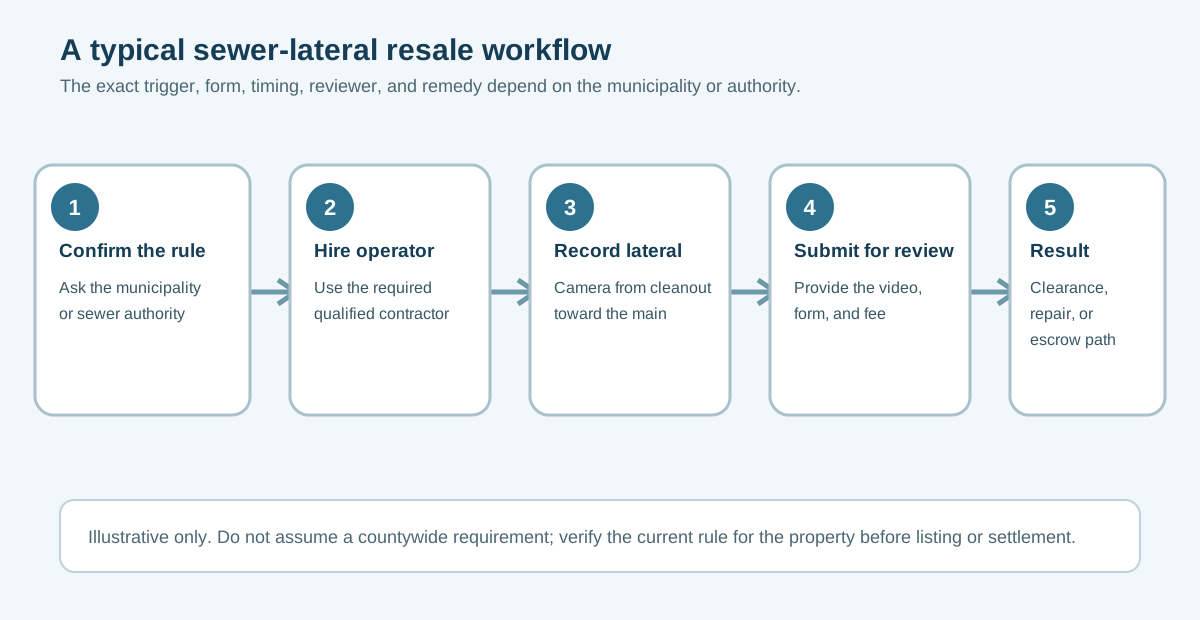
A sewer lateral is the buried pipe that runs from a house to the public sewer main in the street. A point-of-sale inspection is a recorded video of that pipe, typically produced by a licensed plumbing company or contractor pushing a camera from an interior cleanout toward the sewer main. The video is reviewed by the municipality’s engineer (or by the sewer authority acting on the municipality’s behalf) and, if the pipe passes, a certificate is issued. If it fails, the seller is usually required to repair or replace the lateral before settlement, or to escrow money for the work. The point is to keep inflow and infiltration out of the public sewer and to stop a cracked or root-filled lateral from becoming the next-door neighbor’s problem at 2 a.m. The homeowner’s practical takeaway is that this is a real, municipally administered test in any Montgomery County town that has formally adopted one, not an optional home-inspection add-on.
Where the rule is on the books in Montgomery County — and where the picture is murkier
The clearest, currently published lateral-inspection-on-transfer ordinance in Montgomery County that could be directly rechecked from the municipality’s own public source is in Lower Pottsgrove Township.
Lower Pottsgrove Township adopted its Private Sewer Lateral Inspection Ordinance in July 2022 (Ordinance 358). The township’s Sewer Authority page spells out the procedure: a licensed plumbing company or contractor must televise the lateral; within 30 days of settlement the seller (or the seller’s agent) submits a video on a flash drive, Form A, and a $100 fee to the Lower Pottsgrove Sewer Authority, plus a separate Utility Certification Request fee of $25 or $45 to Lower Pottsgrove Township; the township’s engineer reviews the video and issues a certificate if the lateral passes. The township also runs a 10-year re-television cycle for laterals, with notice to the owner. (Fees and the 30-day window are current as of the township’s page on September 14, 2026; confirm before relying on them.)
West Norriton Township, the third name that often comes up in this conversation, does something adjacent but different. The township’s own Inspections page requires a Residential Resale Inspection on every change of residential ownership, run by its Code Enforcement Department against the township’s building and safety codes. The page does not name a sewer lateral television test as part of that inspection, and the building-code page does not name one either. A homeowner in West Norriton should still call the township before listing — municipalities amend ordinances, and a lateral test may be added as a line item, but the public-facing West Norriton pages retrieved on September 14, 2026 do not state one.
Other Montgomery municipalities may have their own rules, but this guide does not treat an indexed title, a contractor’s statement, or a neighboring municipality’s rule as proof. Ask the township or its sewer authority for the current written requirement for the specific property.
What a qualified plumber should actually do during a lateral television
The job, done properly, has a few specific elements that a homeowner can listen for. The plumber should ask where the interior cleanout is, or whether one needs to be installed. They should run the camera from the cleanout to the tap at the sewer main, or as far as they physically can, and narrate what they see. A good recording identifies the pipe material (clay tile, cast iron, PVC, orangeburg), notes offsets at the joints, measures depth to any standing water, and calls out root intrusions, cracks, sags, or partial collapses. The plumber should hand over an electronic file the township will accept — Lower Pottsgrove, for example, asks for a flash drive — and be willing to be the named inspector of record on the form.
A few things a sewer camera does not do, and a homeowner should not let it be used to claim them: it does not test the pressurized potable-water service, it does not certify that a septic tank (if there is one) is structurally sound, and it does not replace a municipal U&O inspection or a home inspector’s report on the rest of the house.
How the inspection fits into a normal settlement timeline
The way these ordinances are written, the lateral test is a settlement condition, not a listing-day activity. In Lower Pottsgrove the documentary record and the fees are due within 30 days of settlement; other towns may use a different window. Practical implications for a homeowner:
- Schedule the televising well before settlement, because a failed lateral can mean excavation, a road-opening permit, and possibly a sewer shutoff coordinated with the authority — none of which happens overnight.
- If the home has a sump pump or roof drain tied into the sanitary lateral, expect the engineer to look at that too. Some townships use the lateral inspection as the lever to enforce disconnections.
- If the home is on-lot (septic), the lateral-ordinance question is the wrong one; the relevant authority is the municipal Sewage Enforcement Officer and PA DEP’s Chapter 73 framework, administered locally. The two regimes are separate.
Questions worth asking the township before you list or buy
A short, specific list goes further than a generic one. Useful signals of a useful answer:
- “Does this township currently require a televised lateral inspection at point of sale, and under which ordinance or resolution number?” A real answer will name the ordinance and the date it was adopted. A vague answer is a reason to ask for the ordinance text.
- “Who reviews it — the township’s engineer, the sewer authority, or both?” This tells you who actually issues the certificate.
- “What is the inspection window relative to settlement, and what is the fee schedule?” Numbers should come from the township’s own page or ordinance, not from a contractor.
- “If the lateral fails, is repair required before settlement, or is escrowing the repair cost an option?” This decides whether the deal can close on time.
- “Are sump pumps, roof drains, or yard drains currently allowed on the sanitary lateral?” Many of these ordinances exist precisely to break those connections.
On-lot (septic) systems are governed by a different rule
If the home is on a septic system rather than public sewer, the “lateral inspection” question takes a different shape. The municipal Sewage Enforcement Officer administers Pennsylvania Department of Environmental Protection regulations in Title 25, Chapters 71, 72, and 73 of the PA Code, as Penn State Extension’s consumer guidance explains. There is no statewide point-of-sale septic inspection, but many lenders, home inspectors, and a few municipalities require one anyway, and an SEO can tell the homeowner whether the local municipality has added any requirement beyond Chapter 73. The two regimes can both show up in the same settlement file and be easy to confuse: the plumber who televises a public-sewer lateral is not the same person who assesses a septic system.
What a homeowner should and shouldn’t do during a lateral scare
A failed lateral video is a moment to slow down, not to start excavation. Three practical boundaries:
- Do not let a contractor open the street or the sidewalk without a road-opening permit from the township and notice to the sewer authority. The authority usually has to be on-site when a tap on the main is made.
- Do not pay for “emergency” lateral replacement on the spot at settlement; the contractor’s invoice is a negotiable part of the deal, not a closing cost set in stone.
- Do not route sump pumps, roof drains, or yard drains into the sanitary lateral to “pass” the test; that is exactly what many of these ordinances are designed to catch, and it can trigger a separate enforcement action.
For a true sewer backup or a manhole surfacing in the yard, the right call is the sewer authority (during business hours) or the township’s emergency line (after hours), not a private contractor — public-sewer emergencies are the authority’s responsibility, not the homeowner’s.
Sources
- Lower Pottsgrove Township Sewer Authority — Sewer Lateral Ordinance — Lower Pottsgrove Township, Montgomery County, PA. Primary source for Ordinance 358 (July 2022), 30-day post-settlement filing window, $100 sewer-authority fee, $25/$45 utility certification fee, Form A + flash-drive video, engineer review, certificate on pass, and 10-year re-television cycle. Retrieved September 14, 2026.
- West Norriton Township — Inspections — West Norriton Township, Montgomery County, PA. Primary source for the township’s Residential Resale Inspection requirement. Retrieved September 29, 2026.
- Penn State Extension — On-Lot Septic System Inspections During Real Estate Transactions — Penn State College of Agricultural Sciences. Academic/extension source on the Sewage Enforcement Officer role and PA DEP Title 25 Chapters 71, 72, and 73 framework as it applies to on-lot systems during real-estate transactions. Retrieved September 29, 2026.