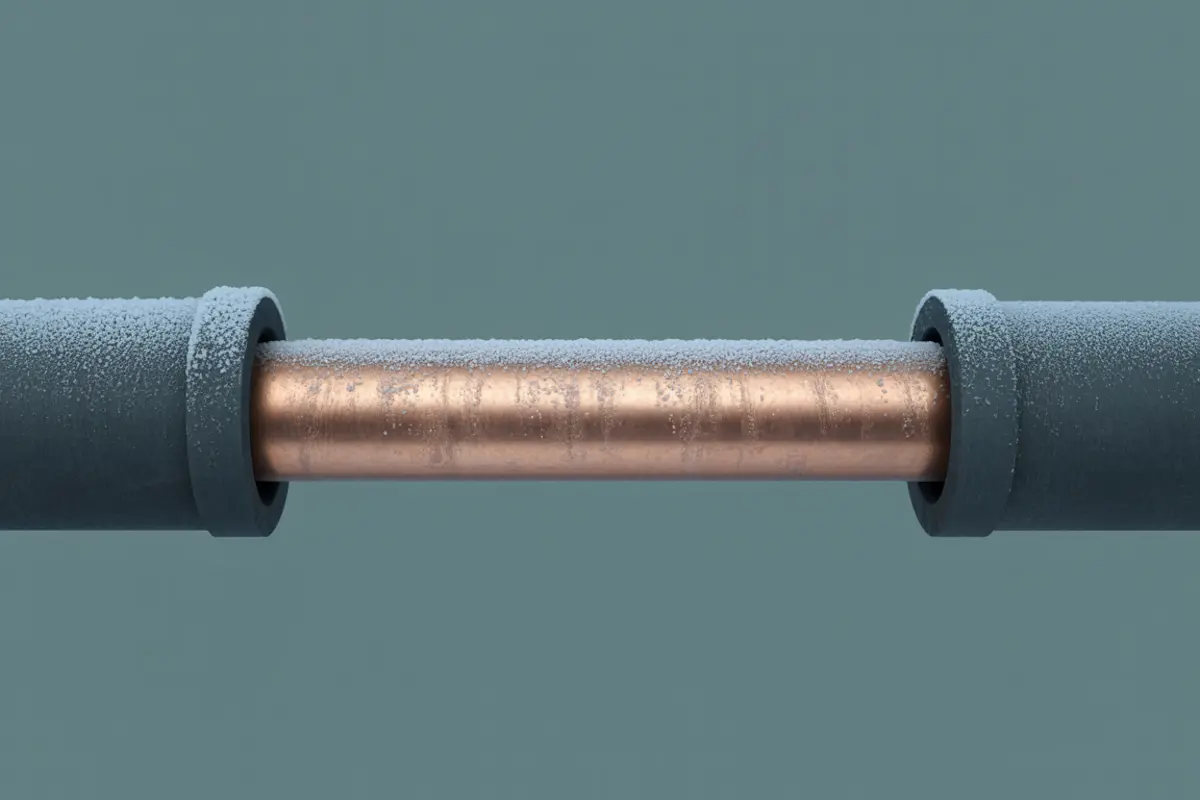
A frozen pipe in a basement is a warning. A burst pipe in a basement is an emergency. The two are connected: water expands as it freezes, the expansion stresses the pipe wall, and a frozen section can split before anyone sees a drip. By the time water appears on the floor, the pipe has often been failing for hours.
This page is a homeowner-facing guide to what frozen and burst pipe service actually covers, how professionals diagnose and repair the problem, what affects the scope of the work, the questions worth raising with a contractor, and the Pennsylvania and Montgomery County–specific licensing and permit questions to confirm before booking.
Specific prices and “typical cost” ranges are intentionally not included here — those vary too much from one home and one failure to another. A written estimate from a qualified plumbing contractor is the right place for numbers.
What “frozen and burst pipe service” actually means
This service covers two connected problems that share a single cause — freezing weather and the way water behaves as it turns to ice:
- Frozen pipe. Water inside a supply pipe has turned to ice, blocking flow. Because water expands as it freezes, the ice puts pressure on the pipe wall. A frozen pipe is a warning sign, not a finished diagnosis.
- Burst pipe. The pipe has split, cracked, or separated at a fitting. The leak often becomes visible only after the pipe thaws and water starts to flow again, which is why a frozen pipe is treated as a potential burst until proven otherwise; after thawing, a hidden split can turn into a surprise leak.
The service spans: locating the frozen or failed section, safely thawing an accessible pipe that has not split, shutting off water to stop active flooding from a burst, repairing or replacing the damaged section, and restoring the system. It overlaps with emergency plumbing (containing active water damage right now) and with leak repair (finding and fixing the source), but the defining trigger is freezing weather and the ice-expansion failure mode.
When homeowners usually seek help
Three situations bring a homeowner to this service:
- Mid-event emergency. A pipe has split, water is running or has run, the homeowner needs the water off and the line fixed. Time matters here.
- Frozen-but-not-yet-burst. A faucet has gone down to a trickle or stopped, frost is visible on an exposed pipe, and the homeowner is deciding between safe thawing and calling for help.
- Pre-event prevention. A homeowner is winterizing ahead of a forecast cold snap, returning to a vacant home that was unheated during a freeze, or recovering from a previous freeze event and looking for ways to reduce the next one.
All three are valid reasons to look up a plumber. The first two carry more urgency and a higher premium on knowing where the main water shutoff is before the event.
Common signs and causes
Signs that prompt a call:
- Little or no water from a faucet during or after a cold snap — a common first sign of a frozen supply line (Consumer Reports).
- Visible frost or bulging on an exposed pipe in a basement, crawl space, garage, or along an exterior wall (Red Cross).
- Water on the floor, dripping from a ceiling, or staining a wall as temperatures rise, indicating a split that was hidden during the freeze.
- The sound of running water with no fixture on, after a thaw.
- A sudden drop in pressure at one or more fixtures.
- An unexplained jump in the water bill after a cold snap.
- A cold or vacant home that has been unheated or minimally heated during sustained freezing weather (IBHS).
A single frozen fixture with no visible damage and no active leak is often manageable with safe thawing. Any sign of an actual split, active water, or a frozen pipe that cannot be reached is a stronger case for a professional visit.
Causes — well-documented failure modes, not a diagnosis of any specific home:
- Ice expansion. Water expands as it freezes. The American Red Cross notes that this expansion can break metal or plastic pipes regardless of the container’s strength.
- Pipes in unheated or poorly insulated areas. The Red Cross identifies the most frequently frozen pipes as outdoor hose bibbs and sprinkler lines, pipes in unheated interior areas (basements, crawl spaces, attics, garages, kitchen cabinets), and pipes running against exterior walls with little or no insulation.
- Cold-air infiltration. Gaps and cracks that let cold air reach pipes, and open garage doors over water lines.
- Thermostat set too low, or heat off. An unheated or under-heated home during a cold snap, especially when vacant. The Insurance Institute for Business & Home Safety (IBHS) recommends keeping the thermostat at least 55°F even when no one is home.
- Hoses left connected. A garden hose attached to an outdoor spigot can trap water and freeze back into the wall.
How professionals diagnose
A frozen/burst visit usually starts with three questions: Is the pipe frozen, or has it already split? Where is the affected section? Is the home still safe?
A plumber typically (1) confirms whether the pipe is frozen or already split, (2) locates the section by tracing the line, checking exposed runs, and using the pattern of which fixtures are affected, (3) shuts off water at the main or a fixture stop to stop active flow, and (4) determines whether the section can be safely thawed or must be cut out and replaced. Diagnosis is site-specific — this page does not prescribe a diagnostic path for any specific home.
The homeowner-facing piece of diagnosis is simple: knowing where the main water shutoff is before an emergency turns a flood into an inconvenience.
Common service and repair paths
Once the situation is confirmed, the work usually falls into one or more of these categories:
- Safe thawing of a frozen (not yet burst) pipe — applying gentle, controlled heat (electric heating pad, hair dryer, warm towels, or a portable space heater kept away from flammable materials) to the frozen section until flow is restored. This is the standard first step when the pipe has not split (Consumer Reports; Red Cross).
- Emergency shutoff and containment — closing the main shutoff to stop active flooding from a burst pipe, then opening faucets to drain the system.
- Section repair — cutting out the split or cracked section and replacing it with copper, PEX, CPVC, or other material matching the existing system.
- Fitting or joint repair — replacing a failed fitting, valve, or connection that separated under freeze pressure.
- Hose-bibb / outdoor spigot repair or replacement — repairing or replacing a frost-damaged outdoor faucet, often with a frost-free (freeze-resistant) sillcock where appropriate.
- Re-route or partial repipe — when freeze damage is widespread or the pipe is in a repeatedly vulnerable location.
- Water-damage referral — after the plumbing is stabilized, the homeowner may separately need water-damage restoration (drying, drywall/flooring repair, mold assessment), which is a different trade.
These are general categories. Specific methods depend on the site, pipe material, access, and local code.
What affects project scope
Scope varies with several factors — none of which this page converts into a price or cost-savings promise:
- Whether the pipe is frozen or already burst — a frozen-but-intact pipe may only need thawing; a split pipe needs repair or replacement.
- Location and accessibility — an exposed basement pipe vs. a pipe inside a finished wall, ceiling, or under a slab.
- Pipe material and age — copper, PEX, CPVC, and galvanized steel all behave differently and have different repair methods.
- Extent of damage — a single split vs. multiple splits vs. a failed fitting vs. widespread freeze damage.
- How long water ran before shutoff — and whether drywall, flooring, insulation, or finishes were affected.
- Access and finish restoration — whether walls, ceilings, or floors must be opened and then repaired.
- Permits and inspections — whether the municipality requires a plumbing permit or inspection for the repair.
- Time of year and urgency — freeze events often cluster. This page makes no claim about response time, availability, or priority.
Questions to ask a contractor
A few questions worth raising before work starts:
- Can you confirm the main shutoff location with me and shut off the water quickly if needed?
- Can you tell whether the pipe is frozen or already split before doing any work?
- What pipe material is in my home, and what material will you use for the repair?
- Will the repair require opening a wall, ceiling, or floor, and who handles the finish restoration?
- Is a permit or inspection required for this repair in my municipality, and who obtains it?
- What is your Pennsylvania Home Improvement Contractor (HIC) registration number, and do you hold any municipal plumbing credential for my municipality? HIC registration is a consumer-protection registration, not a plumbing license — see Montgomery County considerations below.
- Do you carry insurance, and what does it cover for water-damage claims?
- What is your process if the freeze damage is more extensive than it first appears?
- Will you document the damage and repair for my insurance claim?
Maintenance and prevention
Prevention guidance is well-supported by public-safety and utility sources, including the Red Cross, IBHS, and Aqua Pennsylvania (for its customers in parts of Montgomery County):
- Disconnect and drain outdoor hoses before cold weather, and close the inside shutoff valves that supply outdoor hose bibbs.
- Insulate exposed pipes in unheated areas (basements, crawl spaces, attics, garages) with pipe sleeves or pipe insulation.
- Seal air leaks — caulk cracks and gaps around where pipes pass through walls, and keep garage doors closed if water lines run through the garage.
- Open cabinet doors under kitchen and bathroom sinks on exterior walls to let warm indoor air reach the pipes during cold snaps.
- Let a vulnerable faucet drip — a slow trickle of water through a vulnerable line can help prevent freezing by keeping water moving.
- Keep the heat on. IBHS recommends setting the thermostat to at least 55°F even when no one is home. If away longer than a week during sustained subfreezing weather, consider shutting off the main water valve and draining the lowest-floor faucets.
- Consider UL-listed heat tape or heat cable on exposed pipes, following the manufacturer’s instructions. It is an electrical product and is not a substitute for insulation and proper heat.
- Know your main water shutoff — locate and test it before an emergency so you can act quickly.
These are general prevention measures; suitability for a specific home depends on its construction and plumbing layout.
Safety boundaries
A few hard rules, framed for a homeowner deciding what to do and what not to do:
- Never use an open flame to thaw a pipe. Do not use a blowtorch, kerosene or propane heater, charcoal stove, or any open-flame device. High heat can damage the pipe or start a fire. Use gentle, controlled heat — a hair dryer, electric heating pad, warm towels, or a portable space heater kept away from flammable materials — and only on an accessible pipe that has not split (Consumer Reports; Red Cross; Aqua Pennsylvania).
- If the pipe has already burst, thawing will release water. Be prepared to shut off the main water valve before applying heat, and be ready for water to flow (Consumer Reports).
- If you cannot find the frozen area, cannot reach it, or cannot thaw it safely, call a qualified plumber (Consumer Reports; Red Cross).
- Do not attempt gas-line work. This page covers water supply pipes only. Gas piping is a separate, higher-risk system that requires a qualified professional.
- Do not work near energized electrical equipment or standing water. If flooding has reached outlets, appliances, or the electrical panel, stay clear and contact a qualified professional. Water and electricity are a serious hazard.
- Do not expose yourself to sewage. If a freeze has affected a drain or sewer line, or if backup is present, avoid contact and call a professional.
- Heat tape and heat cable are electrical products. Follow the manufacturer’s instructions. Do not overlap non-self-regulating heat tape, and do not use damaged or non-listed products.
Montgomery County considerations
A few things specific to Pennsylvania and Montgomery County, where evidence supports them:
- Plumbing license vs. HIC registration. Pennsylvania does not issue a single statewide plumbing license. Contractors doing $5,000 or more per year of residential home-improvement work must register as a Home Improvement Contractor (HIC) with the PA Office of Attorney General. HIC registration is a consumer-protection registration, not a plumbing license, and not an endorsement of plumbing competency. Local plumbing licenses and registrations vary by municipality — confirm with your municipality before booking work (PA DLI; PA OAG).
- Permits and the PA Uniform Construction Code. Pennsylvania’s Uniform Construction Code (UCC) requires permits before regulated plumbing work and applies inspections to plumbing-system changes, with municipalities enforcing locally. Whether a specific burst-pipe repair requires a permit, or is treated as a like-for-like exempt repair, depends on the municipality. Ask your contractor and your municipality. Montgomery Township, for example, publishes its own codes and permit forms; other Montco municipalities may differ.
- Water utility is address-specific. Aqua Pennsylvania serves parts of Montgomery County (its Southeastern Division includes parts of the county). Other water systems also serve parts of the county, and service is address-specific — confirm your water utility, its winter-prevention guidance, and its shutoff procedures for your address.
- Freeze exposure is real in PA winters. Pennsylvania winters put uninsulated exterior-wall and exterior supply lines at risk during sustained subfreezing temperatures, especially in homes where heat has been set low or turned off for an extended period.
For specific questions about your address — local water and sewer authority, permit triggers, whether a municipal plumbing credential is required, and whether a specific repair needs a UCC inspection — contact your municipality and your water utility directly.
Sources
- American Red Cross — Preventing & Thawing Frozen Pipes — https://www.redcross.org/get-help/how-to-prepare-for-emergencies/types-of-emergencies/winter-storm/frozen-pipes.html
- Consumer Reports — How to Prevent Your Pipes From Freezing and Bursting — https://www.consumerreports.org/home-garden/home-maintenance-repairs/how-to-keep-pipes-from-freezing-a2277945570
- Insurance Institute for Business & Home Safety (IBHS) — IBHS Winter Weather Ready guide provides easy-to-do actions to help prevent property damage from colder temperatures — https://ibhs.org/ibhs-news-releases/ibhs-winter-weather-ready-guide-provides-easy-to-do-actions-to-help-prevent-property-damage-from-colder-temperatures
- Aqua Pennsylvania — Winter Is Freezing, But Your Pipes Don’t Have to Be! — https://www.aquawater.com/news/winter-freezing-your-pipes-dont-have-be-0
- Aqua Pennsylvania — Aqua Urges Customers to Protect Pipes With Potential Winter Storm Looming — https://www.aquawater.com/news/aqua-urges-customers-protect-pipes-potential-winter-storm-looming
- Aqua Pennsylvania — Aqua Pennsylvania (service area: Southeastern Division includes parts of Montgomery County) — https://www.aquawater.com/about-aqua/states-we-serve/aqua-pennsylvania
- Pennsylvania Department of Labor & Industry — Apply for a Uniform Construction Code Building Permit — https://www.pa.gov/services/dli/apply-for-a-uniform-construction-code-building-permit
- Pennsylvania Department of Labor & Industry — Contractor Licensing (Uniform Construction Code) — https://www.pa.gov/agencies/dli/programs-services/labor-management-relations/bureau-of-occupational-and-industrial-safety/uniform-construction-code-home/contractor-licensing
- Pennsylvania Office of Attorney General — Home Improvement Contractor Registration — https://www.attorneygeneral.gov/businesses-and-organizations/home-improvement-contractor-registration/
- Montgomery Township, PA — Codes & Permits — https://www.montgomerytwp.org/department/division.php?structureid=77
- This Old House — How to Prevent Frozen and Burst Pipes — https://www.thisoldhouse.com/plumbing/how-to-prevent-frozen-and-burst-pipes
Related video
How to Prevent Frozen and Burst Pipes
This short demonstration makes the outdoor-spigot shutoff and draining step easier to visualize.
Video: How to Prevent Frozen and Burst Pipes — This Old House.
Context and limits: It is general prevention guidance, not a complete burst-pipe response or a substitute for local code and permit checks.