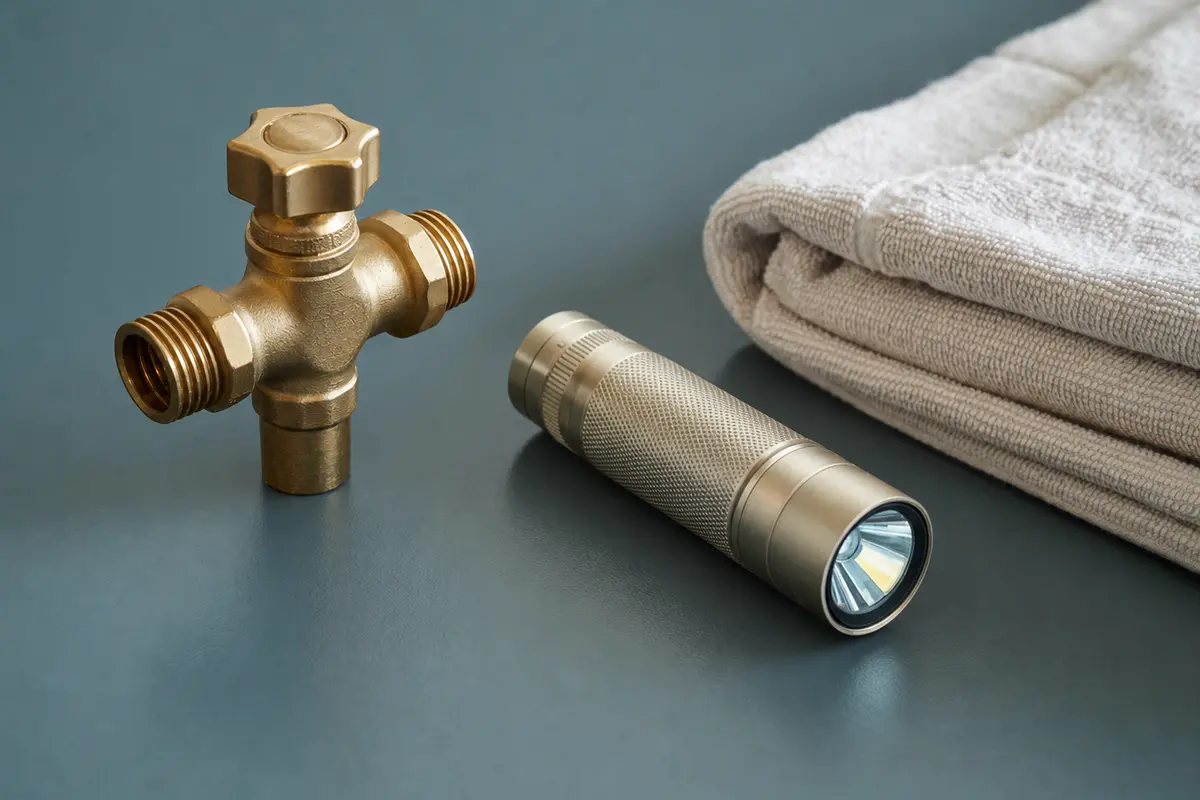
If you have an emergency right now
Two actions cover almost every plumbing emergency:
- Active leak, sewage backup, or no water: shut off the main water valve (or the nearest fixture shut-off) before anything else, then call a licensed or registered plumbing contractor in your municipality. If you do not know where the shut-off is, find and turn the lowest valve you can identify under a sink, behind a toilet, or where the main line enters the home.
- Smell of gas (a rotten-egg or sulfur odor): leave the building immediately. Do not flip switches, light matches, use a phone or appliance, or do anything that can spark. Call 911 and your gas utility from outside. This is a gas-utility and 911 emergency, not a plumbing call.
The rest of this page explains what “emergency plumbing” actually covers in Montgomery County, how professionals diagnose and repair it, what affects the scope of the job, what to ask a contractor before hiring, how to reduce the chance of an emergency, the safety boundaries that should not be crossed by a homeowner, and the local rules that vary from one municipality to the next.
What emergency plumbing is
Emergency plumbing is the immediate, unscheduled work of stopping an active plumbing failure before it causes more damage. The defining feature is urgency: something is leaking, backing up, or failing right now, and the first job is to contain it.
The situations that usually count as emergencies include:
- A burst or actively leaking supply pipe
- A sewage backup or sewer line blockage
- A failed or leaking water heater
- A major fixture or appliance leak that cannot be contained
- Frozen pipes at risk of bursting
- A sump pump failure during flooding conditions
Routine or scheduled work — drain cleaning, fixture replacement, a planned remodel — is not emergency plumbing. The line is drawn at stopping active damage, not at any particular repair technique.
When homeowners usually seek help
Most calls for an emergency plumber start with something the homeowner can see, hear, or smell:
- Visible running water. Water spraying, pooling, or running from a pipe, fixture, appliance, ceiling, or wall.
- Sewage backup. Wastewater coming up through floor drains, toilets, or tubs, or a strong sewage odor indoors.
- No water, or a sudden pressure drop. A supply-line failure or a frozen main.
- Water heater trouble. A leaking tank, no hot water combined with a leak, or a relief valve discharging.
- Frozen pipes. No water from a faucet during freezing weather, or visible frost or bulging on an exposed pipe.
- A suspected gas leak. A rotten-egg or sulfur odor. This is a gas-utility and 911 emergency, not a plumbing call — see the Safety Boundaries section below.
The first question in any of these situations is the same: can I stop the water, and is anyone in danger? The answer decides whether you act first and call second, or call first and act second.
Common signs and causes
The signs above usually trace back to a small set of well-documented failure modes. These are general patterns, not a diagnosis of any particular home.
- Freezing. Water expands as it freezes and can split a pipe. The split often stays hidden until the pipe thaws and water flows again, which is why a freeze can turn into a surprise leak days later (American Red Cross; Protect Your Pipes).
- Corrosion and age. Older galvanized or copper supply lines degrade over time and can fail under normal pressure.
- Pressure spikes. Water hammer, or a failed pressure regulator, can stress joints and fittings until something lets go.
- Clogs and root intrusion. Sewer backups are frequently caused by accumulated grease, “flushable” wipes, or tree roots growing into the lateral line.
- Water heater tank failure. Internal corrosion or a failed relief valve can cause a tank to leak.
None of these is something a homeowner should diagnose from a distance. Knowing the common causes is useful mainly so you can describe the problem accurately when you call for help.
How professionals diagnose the problem
A plumber responding to an emergency generally works through a sequence:
- Stop the active leak or backup. Containment comes first, before any diagnosis.
- Identify the failed component or section. Find exactly what broke or blocked.
- Assess the cause. Freeze damage, corrosion, a clog, a pressure problem, or something else.
- Recommend repair versus replacement. Explain what can be fixed, what should be replaced, and why.
Diagnosis is specific to the equipment and the site. A good contractor will tell you what they found, what they think caused it, and what they recommend — in plain language — before doing the work.
Common service and repair paths
Emergency plumbing work tends to fall into a few broad categories:
- Containment first. Shut off the water to the affected area, stop the active leak, and limit water damage.
- Pipe repair or replacement. Repair a burst section or replace a corroded run.
- Drain and sewer clearing. Auger, hydro-jet, or camera inspection to clear a backup; a camera inspection is commonly used to locate the blockage or damage.
- Water heater repair or replacement. Repair a valve or element, or replace a failed tank.
- Sump pump repair or replacement. Restore or replace a failed pump during flooding conditions.
These are general categories, not a menu of guaranteed outcomes. The right method, the materials, and the repair-versus-replace decision depend on the site, the equipment, and local code.
What affects the scope of the job
Several factors change how big or complicated an emergency job becomes. These are scope drivers, not cost estimates — this page does not publish prices.
- Access. A failed pipe in an open basement is a different job from one behind a finished wall or ceiling, or under a slab.
- Extent of water damage. How much drywall, flooring, or cabinetry is affected, and whether separate water-damage remediation is needed.
- Age and material of the system. Older or non-standard materials may require more extensive replacement.
- Cause. A simple freeze split is different from a recurring root-intrusion sewer problem.
- Code and permit requirements. Whether the repair triggers a permit or inspection under the local municipality’s administration of the Pennsylvania Uniform Construction Code (UCC).
- After-hours timing. Emergency work outside normal hours is a timing factor, not a measure of quality.
Questions to ask a contractor
Ask these before you hire. They are decision points, not endorsements of any business.
- Registration. “Are you registered as a Pennsylvania Home Improvement Contractor (HIC), and can you provide your PA number?” Note: HIC registration is a consumer-protection registration, not a plumbing license.
- Licensing. “Do you hold a plumbing license or master-plumber credential, and in which jurisdiction?” Pennsylvania does not issue a single statewide plumbing license; requirements vary by municipality.
- Insurance. “Are you insured, and can you provide proof?”
- Scope and method. “What is the cause, what exactly will you repair or replace, and why?”
- Permits. “Will this work require a permit or inspection in my municipality, and who handles it?”
- Written estimate. “Can I get the scope and price in writing before work begins?”
- Availability. “What is your actual availability right now, and what are your after-hours terms?” Treat any response-time promise as a claim to verify, not a fact.
Maintenance and prevention
Prevention reduces risk; it does not eliminate the possibility of an emergency. The steps below are supported by public-safety and utility guidance.
- Know your shut-off valve. Locate the main water shut-off before an emergency and make sure everyone in the home knows where it is and how to use it (Regional Water Providers Consortium).
- Prevent frozen pipes. In cold weather, keep the thermostat above 55°F, drip the farthest cold faucet, insulate pipes in unheated areas, open cabinet doors to warm pipes, and drain outdoor spigots before freezing weather (American Red Cross; Protect Your Pipes).
- Protect your drains. Avoid flushing wipes and pouring fats, oils, and grease down drains — both are leading causes of sewer backups (Protect Your Pipes).
- Maintain the water heater. Follow the manufacturer’s maintenance schedule, including periodic flushing and relief-valve checks, to reduce the chance of tank failure.
Safety boundaries
These are hard limits. Do not attempt hazardous work yourself.
- Gas leaks. If you smell gas (a rotten-egg or sulfur odor), leave the building immediately. Do not operate switches, lights, appliances, or anything that could spark. Call 911 and your gas utility from outside. Do not try to locate or repair a gas leak yourself (CDC; National Grid).
- Sewage exposure. Sewage and floodwater can contain harmful bacteria. If sewage is involved, wear rubber boots, rubber gloves, and goggles, keep open cuts covered, and wash thoroughly. Significant sewage cleanup is a professional remediation task (CDC).
- Flooding near electricity. Do not enter standing water that may be in contact with energized equipment or outlets. Shut off power only if it can be done safely without entering the water. If in doubt, call the utility or fire department (CDC).
- Scalding. Do not work on a leaking water heater or relief valve while the tank is hot and pressurized.
- Energized equipment. Do not work on water heaters, sump pumps, or other equipment while they are energized.
Montgomery County considerations
A few local points matter when you are hiring in Montgomery County.
- HIC registration is not a plumbing license. Pennsylvania’s Home Improvement Contractor registration, administered by the Office of Attorney General, is a consumer-protection registration for home-improvement contractors. It does not establish any plumbing license or municipal credential. Do not treat an HIC number as proof of plumbing licensure (PA Office of Attorney General).
- There is no single statewide plumbing license. Whether a specific Montgomery County municipality requires a plumbing license, master-plumber registration, or contractor registration varies by municipality. Confirm the credential with the contractor and the municipality before relying on any “licensed” claim (PA Department of Labor & Industry).
- Permits and code are administered locally. More than 90% of Pennsylvania municipalities administer and enforce the Uniform Construction Code locally. Which emergency repairs trigger a permit or inspection depends on your municipality, not on the county as a whole (PA Department of Labor & Industry).
- The plumbing code is IPC-based. Pennsylvania’s plumbing code is based on the International Plumbing Code (IPC). The exact adopted edition and any local amendments must be confirmed with your municipality (UpCodes / ICC).
- Utility contacts vary by address. The correct gas and water utility emergency numbers depend on your location — PECO, PPL, Aqua, or a local municipal or authority water provider. Confirm the right number for your address before you need it.
Because requirements differ from one municipality to the next, this page does not list per-municipality rules. Check with your own township or borough for the specifics that apply to your address.
Sources
- Pennsylvania Office of Attorney General — Home Improvement Contractor Registration — https://www.attorneygeneral.gov/businesses-and-organizations/home-improvement-contractor-registration/
- Pennsylvania Department of Labor & Industry — Uniform Construction Code (UCC) — https://www.pa.gov/agencies/dli/programs-services/labor-management-relations/bureau-of-occupational-and-industrial-safety/uniform-construction-code-home
- Pennsylvania Department of Labor & Industry — Contractor Licensing — https://www.pa.gov/agencies/dli/programs-services/labor-management-relations/bureau-of-occupational-and-industrial-safety/uniform-construction-code-home/contractor-licensing
- Pennsylvania Plumbing Code 2018 (IPC) — https://up.codes/viewer/pennsylvania/ipc-2018
- Regional Water Providers Consortium — Emergency Water Shut-Off — https://www.regionalh2o.org/emergency-preparedness/emergency-water-shut
- American Red Cross — Preventing & Thawing Frozen Pipes — https://www.redcross.org/get-help/how-to-prepare-for-emergencies/types-of-emergencies/winter-storm/frozen-pipes.html
- Centers for Disease Control and Prevention — Cleaning Safely After a Disaster — https://www.cdc.gov/natural-disasters/safety/index.html
- Protect Your Pipes — Frozen Pipes — https://protectyourpipes.org/frozen-pipes
- National Grid — Gas Emergencies — https://www.nationalgridus.com/Report-Gas-Emergency
- Montgomery Township, PA — Codes & Permits — https://www.montgomerytwp.org/department/division.php?structureid=77
- Springfield Township, Montgomery County, PA — Building Permits & Inspections — https://www.springfieldmontco.org/departments/building-zoning/building-permits-inspections/
- Upper Merion Township, PA — Building Permits — https://www.umtownship.org/176/Building-Permits
Related video
How do I shut off my water valve?
A city-produced demonstration reinforces the most useful first action for many active plumbing leaks: stop the water when it is safe to do so.
Video: How do I shut off my water valve? — City of West Linn.
Context and limits: Valve and meter locations vary. Gas odors, sewage exposure, or water near electricity require the emergency steps in the written guide.