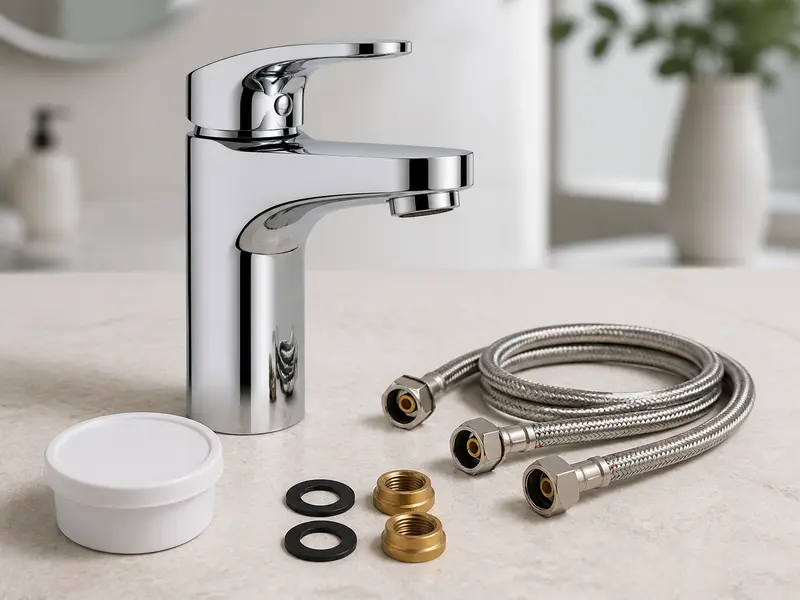
A homeowner’s guide to fixture problems, what a professional service visit typically covers, and how to think about repair versus replacement.
At a glance
- A dripping faucet is almost always a worn washer, O-ring, cartridge, or valve seat — which one depends on the faucet type.
- A shower that drips at the head or spout usually points to the cartridge or valve internals; a leak behind the wall usually means the valve body.
- Reduced flow from one fixture is most often a clogged aerator or showerhead, not a supply problem.
- Permits, where required, are issued by your township or borough, not by Montgomery County.
What this page covers
Faucet, sink, shower, and fixture plumbing covers the work a tradesperson does on the water-delivery fixtures you touch and see every day: kitchen and bathroom sink faucets, showerheads, tub spouts, shower and tub mixing valves, and the supply stops that feed them. The job spans three broad activities:
- Repair — diagnosing why a fixture is dripping, hard to operate, leaking at the base, or producing uneven flow, and replacing the specific part that has failed.
- Replacement — removing an old faucet, showerhead, or shower valve and installing a new one, including supply connections and, for shower valves, work inside the wall.
- Service and tuning — clearing or replacing a clogged aerator or showerhead, addressing mineral buildup, or swapping fixtures to reduce water use.
A faucet is a valve that controls flow from the supply lines to the spout. Most problems trace to a small set of wear parts (washers, O-rings, cartridges, valve seats) or to mineral buildup.
When homeowners usually seek help
Homeowners call for one of three reasons: a leak they can’t stop, a fixture that no longer works the way they expect, or a planned upgrade. The most common triggers:
- A faucet that drips from the spout after the handle is closed.
- Water appearing around the base of a faucet or under the handle.
- A showerhead that drips after shutoff, or a shower valve that leaks inside the wall.
- A handle that has become stiff, squeaky, or difficult to turn.
- Noticeably reduced flow from a faucet or shower.
- Sudden hot or cold swings in the shower when another fixture is used.
- Visible white or greenish crust around the spout, aerator, or handle.
- A planned replacement during a remodel, or a swap to a more water-efficient fixture.
These are symptoms, not diagnoses. A dripping faucet can have several different causes depending on the type of faucet; a separate toilet repair problem has its own diagnosis path.
Common signs and causes
Across compression, cartridge, ball, and ceramic-disc faucets, the same handful of wear parts account for most leaks:
- Worn washers or O-rings. Compression faucets shut off when a rubber washer presses against a metal seat; the washer wears over time and the seal fails. O-rings seal the handle stem and can degrade with age.
- Worn cartridges. Single-handle cartridge, ball, and ceramic-disc faucets use an internal cartridge to control flow and temperature. When it wears or accumulates debris, the faucet drips, becomes stiff, or leaks around the handle.
- Corroded valve seats. The metal seat a washer or cartridge presses against can corrode, preventing a tight seal.
- Clogged aerators and showerheads. Mineral deposits and sediment collect at the spout tip or inside the showerhead, causing reduced flow, sputtering, or uneven spray.
- Failed shower cartridges or valves. A shower that drips from the showerhead or tub spout after shutoff, or that leaks inside the wall, usually points to a worn cartridge or valve internals.
- High supply pressure. Excessively high static pressure can shorten cartridge and washer life and worsen small leaks.
Hard water accelerates several of these failure modes. Where buildup recurs, a water-softening or treatment approach is a separate consideration from the fixture repair.
How professionals diagnose
A good service visit starts with identification, not parts-swapping:
- Identify the faucet or valve type. Compression, cartridge, ball, and ceramic-disc faucets have different internal parts and repair paths. The type installed determines which wear parts to inspect.
- Inspect the aerator or showerhead. The screen is unscrewed and checked for mineral buildup before going deeper into the valve.
- Check supply pressure. A reading at a hose bib or under-sink shutoff rules out a system-wide pressure problem.
- Locate the leak. A drip from the spout is usually an internal-part issue. A drip from the wall behind a shower valve, or a stain on the ceiling below, points to the valve body or supply connections.
- For replacement, confirm configuration. Mounting-hole count, center-set vs. widespread spacing, the shower valve’s rough-in depth and brand, and the existing supply connections determine which replacement fixtures will fit.
The point is to match the repair to the actual cause, not to replace parts on speculation.
Service and repair paths
Common professional paths:
- Washer or O-ring replacement. The least invasive repair, typically used on compression (two-handle) faucets.
- Cartridge replacement. The most common repair on cartridge, ball, and ceramic-disc faucets and on shower valves that drip from the showerhead or tub spout.
- Valve-seat service. Resurfacing or replacing a corroded seat where a washer or cartridge is failing to seal.
- Aerator cleaning or replacement. Restoring full flow by clearing or replacing the screen at the spout tip.
- Showerhead replacement. Swapping a clogged or inefficient showerhead; the simplest path to a water-use upgrade.
- Full faucet or shower-valve replacement. Removing the old fixture and installing a new one, including supply connections and, for shower valves, work inside the wall. The most involved path; can include wall opening and finish work.
The right path depends on the fixture and the failure: a dripping compression faucet is usually a washer fix; a dripping single-handle faucet or shower usually points to a cartridge; an old, corroded fixture may be a better replacement candidate than another repair.
What affects scope
Several factors change how involved a fixture job is, though none predict the price:
- Faucet type. Compression, cartridge, ball, and ceramic-disc faucets have different internal parts and repair complexity.
- Where the leak is. A spout drip is usually an internal-part fix; a leak behind a shower wall can require opening a finished wall.
- Access. A shower valve buried in a finished wall is harder to reach than an exposed sink faucet. Tile or stone surrounds add complexity.
- Fixture configuration. Mounting-hole count, center-set vs. widespread spacing, and the shower valve’s rough-in depth and brand affect what replacement fixtures will fit.
- Water quality and pressure. Hard water accelerates mineral buildup and part wear. System-wide high pressure may need a pressure-reducing valve, a separate scope item.
- Efficiency choice. Replacing an older faucet (about 2.2 gpm) or showerhead (about 2.5 gpm) with a WaterSense-labeled model (1.5 gpm or 2.0 gpm) is a common upgrade. Per the U.S. EPA WaterSense bathroom-faucet page, a WaterSense bathroom sink faucet and aerator use at most 1.5 gpm, a reduction of 30 percent or more from the standard 2.2 gpm, with average family savings of about 700 gallons per year.
- Permit and inspection. Some jobs fall under the Pennsylvania UCC and may require a permit depending on the municipality and scope (see Montgomery County considerations).
Cost varies by home, market, and what the diagnosis turns up. This page does not provide cost ranges, savings estimates for a specific home, or any outcome guarantee.
Questions to ask a contractor
Before authorizing work, ask:
- Are you registered as a Pennsylvania Home Improvement Contractor (HIC) with the PA Office of Attorney General, and what is your HIC number?
- Does this work require a permit in my municipality, and who pulls it?
- Is the recommended path a repair or a replacement, and what is the specific cause you found?
- What type of faucet or valve do I have, and what part needs to be replaced?
- If replacing, do you recommend a WaterSense-labeled faucet (1.5 gpm or less) or showerhead (2.0 gpm or less), and why?
- For a shower leak, is the leak at the spout or showerhead, or behind the wall — and will you need to open the wall?
- What is included and excluded (haul-away of the old fixture, wall repair after valve work, finish work)?
- What warranty do you provide on parts and workmanship?
- Can you provide proof of insurance and a written contract?
A Pennsylvania HIC registration, per the PA Office of Attorney General and the PA Department of Labor & Industry, is an administrative consumer-protection registration, not a competency credential or a plumbing license. Plumbing licensure, where it exists, is set by local municipalities. An HIC registration alone does not tell you whether the contractor has the technical training for your specific job.
Maintenance and prevention
A few habits extend fixture life and reduce water waste, though no maintenance routine prevents wear parts from eventually failing:
- Fix drips promptly. A continuously dripping faucet wastes water; the most common causes (worn washers, O-rings, cartridges) are routine replacements.
- Clean aerators and showerheads periodically. Mineral buildup is a common cause of reduced flow and is easy to clear.
- Consider a WaterSense upgrade when replacing. Per the U.S. EPA WaterSense showerhead page, swapping a standard 2.5 gpm showerhead for a WaterSense-labeled 2.0 gpm model saves about 2,700 gallons per year for an average family. WaterSense criteria currently cover private lavatory and bar faucets, not kitchen faucets.
- Check for rebates with your water provider. Some utilities offer WaterSense faucet or showerhead rebates; availability varies and should be confirmed with the specific utility serving the address.
- Address recurring hard-water symptoms. If mineral buildup returns quickly after cleaning, a water-softening or treatment approach may reduce future fixture wear — a separate scope from the fixture repair.
Safety boundaries
Fixture work is generally low-risk, but a few boundaries matter:
- Do not disable or bypass temperature-limiting or pressure-balancing valves. Shower and tub fixtures are subject to anti-scald temperature limits. Model plumbing codes cap mixed-water discharge temperature at about 120°F at the showerhead, achieved through ASSE 1016 automatic compensating valves. Removing or defeating those devices creates a scalding risk, especially for children and older adults.
- Shut off power at the breaker if a leak is near electrical outlets, wiring, or appliances. Do not work near energized equipment while water is present.
- Leave in-wall plumbing to professionals. Shower-valve replacement can require opening a finished wall and working near supply lines. Finish work (tile, drywall) is a separate scope to discuss up front.
- Choose “lead free” fixtures for potable water. Under the federal Safe Drinking Water Act, per the U.S. EPA’s lead-free rule, plumbing fixtures used for drinking water must meet a “lead free” definition of a weighted average of 0.25 percent lead across wetted surfaces. Look for fixtures certified to that standard.
No step-by-step DIY instructions for in-wall plumbing, gas, sewage, or energized equipment appear on this page. When in doubt, hire a licensed professional.
Montgomery County considerations
A few local items take extra checking:
- Permits are administered at the municipality level. Per the Commonwealth of Pennsylvania UCC permit page, Montgomery County does not issue standard building permits; under the PA UCC, individual townships and boroughs administer and enforce the code. The permitting authority for a given address should be confirmed with the local municipality.
- Whether a faucet or shower-valve job requires a permit depends on the scope and the municipality. Minor repairs such as replacing a washer or cartridge generally do not require a permit; work that alters the plumbing system may. The exact boundary should be confirmed with the local code official.
- There is no statewide Pennsylvania plumber license. Per the PA Department of Labor & Industry, some municipalities have local licensure or certification for plumbers; whether yours requires one should be verified locally.
- HIC registration is separate from a plumbing license. Pennsylvania requires home improvement contractors performing qualifying work to register with the PA Office of Attorney General under the Home Improvement Consumer Protection Act. That registration is a consumer-protection requirement; it is not a competency credential and does not replace local plumbing licensure.
- Water service varies by address. Montgomery County is served by multiple providers, including Aqua Pennsylvania in parts of the county and North Penn Water Authority in the Lansdale and North Penn area, among others. The serving provider for a given address can be checked against the county’s water-service-area map (per the Montgomery County ArcGIS Open Data dataset), and any current faucet or showerhead rebate should be confirmed directly with that provider.
- Code edition matters. Pennsylvania has been transitioning to the 2021 I-Codes effective in 2026; the applicable edition and the exact anti-scald temperature requirement should be confirmed with the local code official.
Sources
- U.S. EPA — Bathroom Faucets (WaterSense). https://www.epa.gov/watersense/bathroom-faucets
- U.S. EPA — Showerheads (WaterSense). https://www.epa.gov/watersense/showerheads
- U.S. EPA — Use of Lead Free Pipes, Fittings, Fixtures, Solder, and Flux for Drinking Water. https://www.epa.gov/sdwa/use-lead-free-pipes-fittings-fixtures-solder-and-flux-for-drinking-water
- Pennsylvania Office of Attorney General — Home Improvement Contractor Registration. https://www.attorneygeneral.gov/businesses-and-organizations/home-improvement-contractor-registration/
- Pennsylvania Department of Labor & Industry — Contractor Licensing. https://www.pa.gov/agencies/dli/programs-services/labor-management-relations/bureau-of-occupational-and-industrial-safety/uniform-construction-code-home/contractor-licensing
- Commonwealth of Pennsylvania — Apply for a Uniform Construction Code Building Permit. https://www.pa.gov/services/dli/apply-for-a-uniform-construction-code-building-permit
- UpCodes — Mixed Water Temperature Control (model plumbing code reference). https://up.codes/s/mixed-water-temperature-control
- Montgomery County (ArcGIS Open Data) — Montgomery County Water Service Areas. https://data-montcopa.opendata.arcgis.com/datasets/montcopa::montgomery-county-water-service-areas/explore
- Aqua (Essential Utilities) — Aqua Pennsylvania. https://www.aquawater.com/about-aqua/states-we-serve/aqua-pennsylvania
- North Penn Water Authority — Home. https://npwa.org/
- NSF — Safe Drinking Water Act Requirements. https://www.nsf.org/knowledge-library/safe-drinking-water-act-requirements
- This Old House — How To Fix a Leaky Faucet. https://www.thisoldhouse.com/kitchens/how-to-stop-kitchen-faucet-leaks
Related video
Replace Your Faucet Aerator — WaterSense Bath Hack #2
EPA WaterSense demonstrates a simple aerator replacement and the connection between fixture flow and household water efficiency.
Video: Replace Your Faucet Aerator — WaterSense Bath Hack #2 — U.S. Environmental Protection Agency.
Context and limits: It covers only an aerator, not faucet cartridges, supply connections, concealed valves, or in-wall repairs.