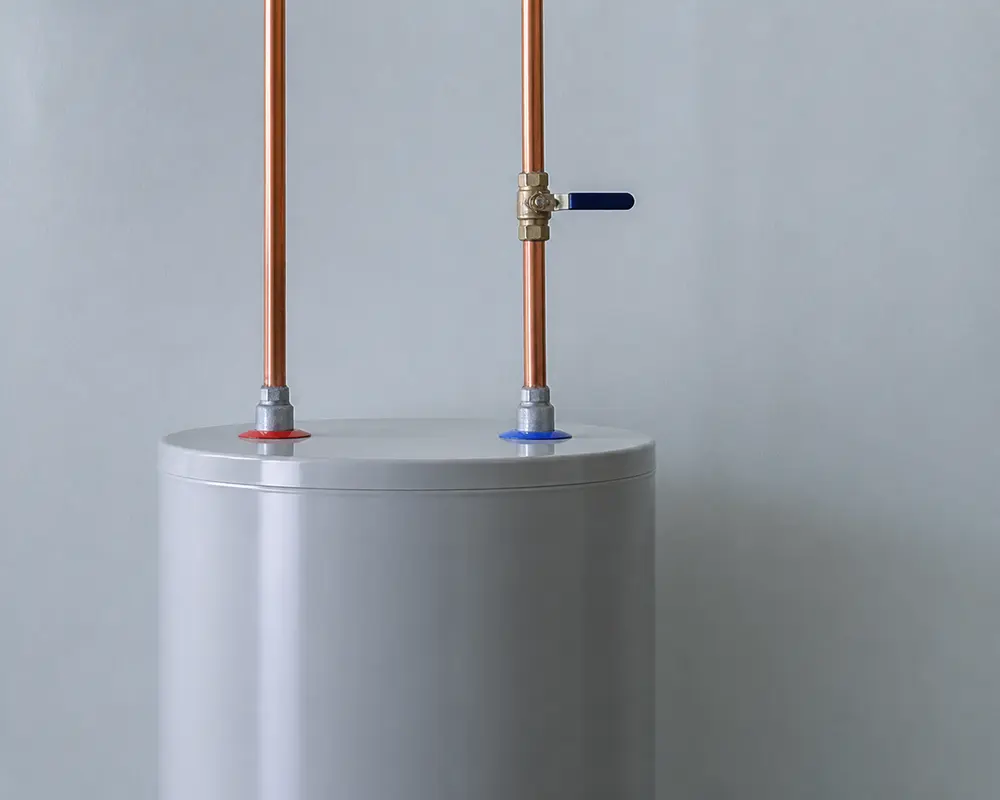
A water heater is one of the quietest pieces of equipment in a home — until it isn’t. Most homeowners first notice a problem as a small shift: a shower that runs cool sooner than it used to, a faint rumble from the basement, a thin line of rust under a fitting, or a sulfur smell in the first hot tap of the morning. None of those alone is an emergency. Together, they usually mean a homeowner is about to ask the question this page is built around: repair or replace?
This page is for Montgomery County, Pennsylvania homeowners trying to make that decision. It covers what the service includes, common failure modes, how a qualified plumber diagnoses a problem, the paths a repair or replacement can take, what to ask a contractor, and what to verify locally. It does not quote prices, promise response times, or rank contractors.
What this service actually covers
The phrase “water heater repair and replacement” hides two different kinds of work.
Repair means a single component has failed on a unit that is otherwise sound — a thermostat, heating element (electric), gas control valve or thermocouple (gas), temperature-and-pressure (T&P) relief valve, dip tube, or sacrificial anode rod. A repair restores function without touching the tank or fuel type.
Replacement means removing the existing unit and installing a new one. That can be a like-for-like swap or a change in fuel or style — a new storage-tank unit, a tankless (on-demand) unit, or a heat pump water heater.
The defining decision is whether the problem lives in a part or in the tank itself. Parts are replaceable. A corroded steel tank is not.
When homeowners usually call for help
People call for one of three reasons, and the right service depends on which one is true.
- Something has stopped working. No hot water at all, or the unit trips a breaker or fails to light. Usually component repair or, if the unit is old, replacement.
- Something is wrong but the unit is still working. Hot water runs out faster, a puddle reappears, a low rumble, rusty or smelly hot water. The system is degrading — there is a window to act.
- The unit is simply getting old. A unit past its expected service life may be replaced preemptively, especially during a remodel or before listing a home. The most controllable situation.
A useful question: how much warning did I get? A small drip that has been there for months is a different conversation from a tank that suddenly begins leaking at the base.
Common signs and what causes them
Most water heater failures come from a small set of causes. None of these is a diagnosis of your specific home; they are the patterns a contractor uses to read a problem.
- Sediment at the bottom of the tank. Hard water leaves mineral deposits that harden into a layer under the burner or element. The layer traps heat, makes the unit work harder, and produces the rumbling or popping noise many homeowners describe as “sounds like it’s boiling.” Over time, sediment accelerates corrosion and shortens tank life [Rheem].
- A depleted anode rod. A storage tank has a magnesium or aluminum sacrificial anode whose job is to corrode in place of the tank steel. When the rod is gone, the tank begins to corrode — typically rust-colored hot water, then a leak at the shell [Rheem].
- Failed electrical components (electric units). A burned-out heating element or a miscalibrated thermostat can leave you with no hot water, lukewarm water, or water that gets hot only intermittently.
- Failed gas components (gas units). A faulty thermocouple, a worn gas control valve, or a clogged burner orifice can prevent ignition or cause the burner to keep shutting off mid-cycle.
- Tank shell corrosion. Once the tank itself leaks, the unit is at the end of its service life. A leak in the shell is not repairable; standard industry guidance is replacement [Rheem; A.O. Smith].
- Bacterial activity in the tank. A sulfur or “rotten egg” odor from the hot water — particularly in a unit that sits at a lower temperature or is used intermittently — usually points to bacteria reacting with the anode rod or sulfate in the water [Rheem].
Mapping symptom to cause helps you listen to a contractor and ask better follow-up questions.
How a qualified plumber actually diagnoses
A water heater diagnosis is shorter than most homeowners expect because the failure modes are well known. A visit typically moves through four steps:
- Confirm fuel type and exact symptom. Gas or electric, storage tank or tankless, age, what the homeowner is seeing.
- Check the simple things. Thermostat setting, the T&P relief valve, the dedicated electrical circuit or gas shutoff, and the age plate on the unit.
- Locate the source of any moisture. A drip from a fitting, the drain valve, or the T&P discharge pipe is repairable. A wet tank shell is not.
- Decide between repair and replacement. The plumber weighs the unit’s age, internal condition, water quality, and the specific failure. The recommendation should make sense in terms of those four factors.
A good diagnosis is short, specific, and explains what the contractor ruled out as well as what they found. If you don’t get that, ask.
Common service and repair paths
There are six common paths. The right one depends on the unit, the home, and the local code.
- Component repair. Replacing a thermostat, heating element, anode rod, T&P relief valve, gas control valve, or dip tube. The standard path for a younger, otherwise-sound unit with a single failure.
- Tank flush and sediment removal. Draining the tank and flushing out accumulated sediment. Best understood as maintenance; it slows sediment-driven wear without reversing it.
- Anode rod replacement. A targeted maintenance step that swaps in a new sacrificial rod to slow internal corrosion.
- Full replacement, like-for-like. Removing the old unit and installing a new storage-tank water heater of the same fuel type. The most common replacement path after a tank failure or at the end of an old unit’s life.
- Tankless / on-demand upgrade. Replacing a storage tank with a unit that heats water only as it is needed. Eliminates standby storage losses, but the home’s gas line capacity, electrical service, venting, and usage pattern all affect whether it is a sensible fit.
- Heat pump water heater upgrade. Replacing an electric resistance unit with a heat pump water heater, which moves heat from the surrounding air into the water. Heat pump units use substantially less electricity than standard electric resistance units [ENERGY STAR]. Switching from a gas, oil, or propane unit to an electric heat pump unit also removes a potential source of carbon monoxide and nitrogen dioxide from the home, though it requires suitable space, electrical service, and a path for the cool air and condensate the unit produces [ENERGY STAR; U.S. Department of Energy].
The diagnosis sets the options. The right path for your home is not a decision to make before that.
What affects the scope of the job
Scope varies by factors that have nothing to do with the contractor you hire. Without converting any of these into a price, here is what determines how involved a job is:
- Repair versus replacement. A component repair is typically a single visit. A replacement means draining and removing the old unit, disconnecting fuel and water, setting the new unit, reconnecting, and bringing it into service.
- Fuel type and venting. Gas units require combustion air and proper venting; electric units need a dedicated circuit of the correct amperage. A change of fuel type adds electrical or venting work.
- Unit type. Storage tank, tankless, and heat pump all have different clearance, electrical, and venting requirements.
- Location and access. A basement utility room is a different job from a tight attic, second-floor closet, or low crawlspace.
- Water quality. Hard water accelerates sediment and shortens anode-rod life.
- Code and permit requirements. Whether your municipality requires a permit and inspection varies by location — see the Montgomery County section below.
Anything that looks like a “typical cost” online is not a substitute for a written estimate from a contractor who has actually looked at your unit, your home, and your local rules.
Questions to ask a contractor
A few well-chosen questions help you understand what you are buying.
- Are you registered as a Pennsylvania Home Improvement Contractor (HIC), and do you also hold any municipal plumbing license or registration required where I live? These are different things — see the local section.
- Based on what you see, is this a repair or a replacement, and what makes it one rather than the other?
- If the leak is coming from the tank shell itself, what does that mean for my options?
- What fuel types and unit types make sense for my home, and which would you choose and why?
- Will you pull the required permit and schedule the inspection, or is that my responsibility?
- What is included in the written estimate, and what would trigger additional work — venting changes, electrical upgrades, code-related corrections?
- What does your warranty cover, for how long, and what does it require me to do?
The biggest decisions are usually repair versus replace, whether to keep the same fuel type or change, and whether a heat pump water heater is realistic given the home’s electrical service.
Maintenance that actually helps
Habits don’t make a water heater immortal, but they slow down the most common causes of failure.
- Keep the temperature at 120°F. The U.S. Consumer Product Safety Commission recommends 120°F to reduce scald risk while saving energy [CPSC]. Most manufacturers preset units to 120°F [A.O. Smith]. Higher settings require thermostatic mixing valves at the point of use. Water at 140°F can cause burns in about six seconds, and water at 150°F can cause third-degree burns in about two seconds [CPSC].
- Flush the tank periodically. Removes sediment that causes noise, reduces efficiency, and shortens tank life [Rheem]. Frequency depends on water hardness.
- Inspect and replace the anode rod. The sacrificial anode rod is designed to be replaced. Replacing it when depleted is one of the most effective ways to extend the life of a steel tank [Rheem].
- Test the T&P relief valve. A critical safety device that relieves excess temperature and pressure to keep the tank from rupturing [National Board]. Manufacturers generally recommend periodic testing.
- Keep a working carbon monoxide alarm on every level. Gas water heaters (and other fuel-burning appliances) produce carbon monoxide. Proper venting and a working CO alarm are essential, and fuel-burning equipment should be inspected annually [Mississippi State Department of Health].
These habits don’t eliminate age-related tank corrosion or defective components. They do shift the odds meaningfully in your favor.
Safety boundaries
A few things belong on this page because they are not obvious to most homeowners.
- Temperature. Don’t set a water heater above 120°F casually. Higher temperatures scald faster and require thermostatic mixing valves at the point of use [CPSC; A.O. Smith].
- T&P relief valve discharging water or steam. If the valve is discharging water or steam, the only safe step is to remove the heat source — shut off the gas supply at the gas unit, or trip the circuit breaker at the electric unit — and call a qualified plumber. Don’t try to relieve the pressure yourself, don’t add cool water to the tank, and don’t try to cool the tank with a hose [National Board].
- Gas and carbon monoxide. Gas water heaters produce carbon monoxide. Proper venting and a working CO alarm are essential, and fuel-burning appliances should be inspected annually [Mississippi State Department of Health]. Gas-line, venting, and combustion work is not a DIY task and is not covered by this page.
- Electricity. Any electrical work on an electric water heater requires shutting off power at the breaker and is best left to a qualified professional.
- No DIY replacement. Removing or installing a water heater is licensed and registered professional work, not a homeowner task.
- No promises on this page. No response times, outcomes, cost savings, code compliance, or contractor availability are promised. Anything that sounds like a guarantee should come in writing from the contractor.
Montgomery County considerations
A few local points matter, and several require checking with your own municipality before work begins.
- Permit triggers vary by municipality. Under the Pennsylvania Uniform Construction Code, a permit is generally required to “erect, install, enlarge, alter, repair, remove, convert or replace” a plumbing system, with an exemption for “replacement of a minor part that does not alter approval of equipment or make the equipment unsafe” [34 Pa. Code § 403.42]. Whether a specific water heater replacement in a given municipality requires a permit — and whether a like-for-like swap counts as exempt maintenance — should be verified with your municipality.
- The adopted plumbing and fuel-gas code edition varies. Your municipality or county building department can confirm what applies to your address.
- HIC registration is not a plumbing license. Pennsylvania does not issue a single statewide plumbing license. Contractors doing $5,000 or more per year of residential home-improvement work must register as a Home Improvement Contractor (HIC) with the Pennsylvania Office of Attorney General. That registration is a consumer-protection requirement, not a plumbing license, and is not an endorsement of competency [PA Office of Attorney General; PA Department of Labor & Industry]. Whether your municipality requires a separate plumbing license or master-plumber registration varies and should be verified locally.
- Local utility rebates and incentives vary. Whether the local electric or gas utility offers rebates for heat pump or high-efficiency water heaters is not addressed here and should be confirmed with your utility before planning an upgrade.
This page is a county-level overview, not a substitute for checking the rules that apply to your specific address.
Sources
- U.S. Consumer Product Safety Commission — Avoiding Tap Water Scalds — https://www.cpsc.gov/s3fs-public/5098-Tap-Water-Scalds.pdf
- National Board of Boiler and Pressure Vessel Inspectors — Residential Water Heater Safety — https://www.nationalboard.org/index.aspx?ID=247&pageID=164
- A.O. Smith — How to Adjust Temperature on Gas Water Heater Safely — https://www.hotwater.com/info-center/water-heater-temperature-setting.html
- A.O. Smith — When to Repair or Replace Your Water Heater — https://www.hotwater.com/info-center/when-to-repair-or-replace.html
- Rheem Manufacturing — 5 Signs Your Water Heater Is Going Bad (And What to Do About It) — https://www.rheem.com/water-heating/articles/5-signs-your-water-heater-is-going-bad-and-what-to-do-about-it
- ENERGY STAR (U.S. EPA / DOE) — Super-Efficient Water Heater — https://www.energystar.gov/products/energy_star_home_upgrade/super_efficient_water_heater
- U.S. Department of Energy — DOE Finalizes Efficiency Standards for Water Heaters — https://www.energy.gov/articles/doe-finalizes-efficiency-standards-water-heaters-save-americans-over-7-billion-household
- Pennsylvania Code — 34 Pa. Code § 403.42 (Permit requirements and exemptions) — https://www.pacodeandbulletin.gov/Display/pacode?file=%2Fsecure%2Fpacode%2Fdata%2F034%2Fchapter403%2Fs403.42.html&d=reduce
- Pennsylvania Office of Attorney General — Home Improvement Contractor Registration — https://www.attorneygeneral.gov/businesses-and-organizations/home-improvement-contractor-registration/
- Pennsylvania Department of Labor & Industry — Contractor Licensing (Uniform Construction Code) — https://www.pa.gov/agencies/dli/programs-services/labor-management-relations/bureau-of-occupational-and-industrial-safety/uniform-construction-code-home/contractor-licensing
- Mississippi State Department of Health — Avoiding Carbon Monoxide Dangers — https://msdh.ms.gov/page/23,4423,195,156.html
Related video
How to Flush a Water Heater
This brief demonstration shows why sediment flushing appears in conventional tank water-heater maintenance discussions.
Video: How to Flush a Water Heater — This Old House.
Context and limits: Hot water, pressure, fuel, electricity, and a faulty drain valve can create hazards. Follow the manufacturer’s instructions or use a qualified professional.