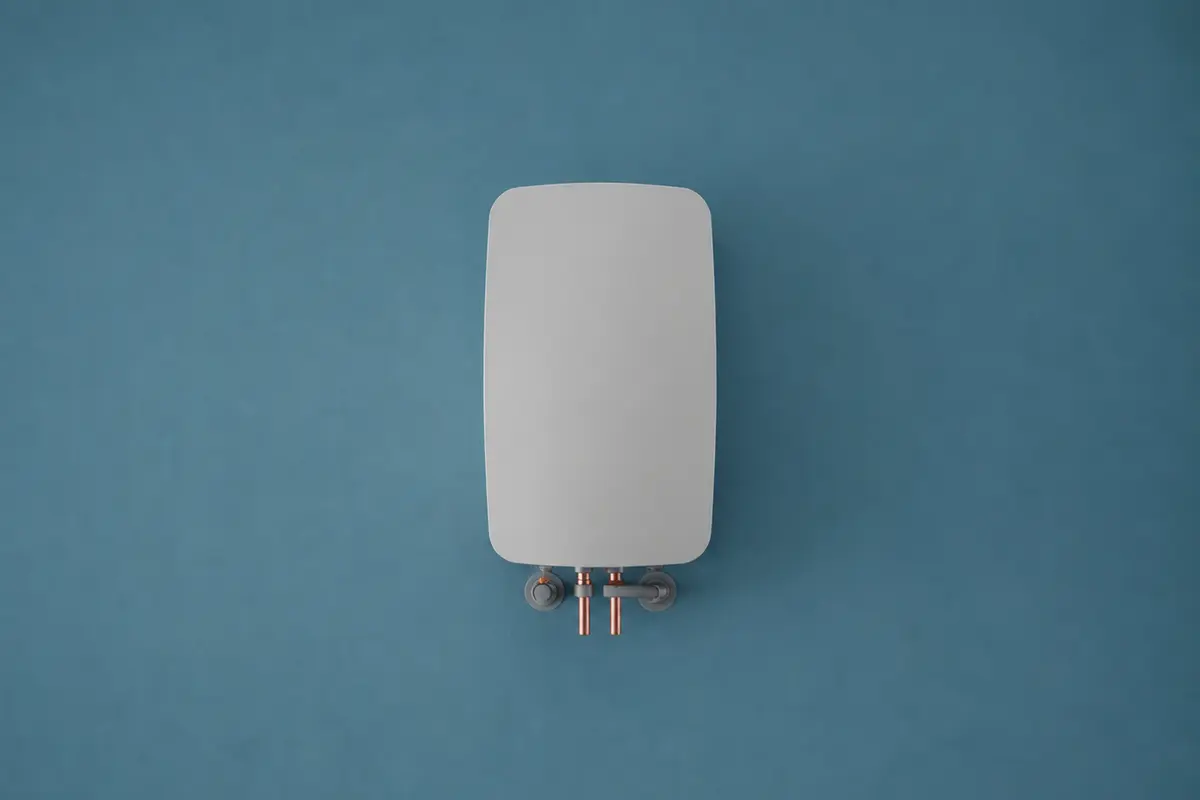
A tankless (on-demand) water heater heats water only when a hot tap is opened — it does not keep a tank of water hot around the clock — so a tank-to-tankless conversion, a tankless service call, or a tankless replacement all involve real trade-offs in fuel type, sizing, venting, maintenance, and permits. This page is for Montgomery County, Pennsylvania homeowners who are weighing whether to convert from a storage-tank water heater, evaluating a tankless unit that is already installed, or trying to understand what service and installation actually cover. It explains how the technology works, how professionals diagnose problems, the common service and repair paths, what affects the scope of a job, what to ask a contractor, how to maintain the unit, where the safety boundaries sit, and what to verify locally before work begins. It does not quote prices, promise response times, or rank one contractor over another.
Quick answer: Tankless service in Montgomery County generally covers installation (including gas, venting, condensate, or electrical work), repair of components like the flow sensor, igniter, heat exchanger, or control board, and maintenance such as descaling and inlet-filter cleaning. Whether a permit is required for a given installation is decided by your municipality under the Pennsylvania Uniform Construction Code, and the right unit is sized to your home’s simultaneous hot-water demand and incoming water temperature — not by tank capacity.
What tankless water heater service covers
Tankless service work generally falls into three related buckets. Each covers a different kind of visit, and a single job can touch more than one.
- Installation. Removing an existing storage-tank or older tankless unit and installing a new tankless unit, including the gas or electric connections, venting, condensate drainage where required, and any water-line changes. A first-time installation is also called a tank-to-tankless conversion.
- Repair. Diagnosing and fixing a failing tankless unit. The most common component-level failures involve the flow sensor, igniter, control board, fan, or heat exchanger.
- Maintenance. Periodic descaling of the heat exchanger, cleaning the inlet water filter, and inspection of venting and combustion components on gas units.
Two characteristics define the technology — and the service that goes with it:
- On-demand heating. The unit fires only when a hot tap is opened and stops the moment the tap closes, avoiding the standby losses of a storage tank (ENERGY STAR).
- Flow-rate sizing. Capacity is measured in gallons per minute (GPM) plus the temperature rise the unit can deliver, not in gallons of stored water (Navien). The unit must be sized to the home’s simultaneous demand, not picked from a tank-capacity number.
When homeowners usually seek help
Most people do not think about a water heater until something forces the issue. The reasons homeowners call for tankless service cluster around a few situations, and the right response depends on which one applies.
- Considering an upgrade. A storage-tank unit is aging out, and the homeowner wants to evaluate whether tankless is a good fit for the home and fuel type.
- Running out of hot water. Showers turn lukewarm when another fixture is running, or hot water cuts out partway through use. This often points to undersizing for simultaneous demand rather than a failed component.
- The “cold water sandwich.” A short burst of cold water a few seconds after reopening a hot tap. This is a known characteristic of on-demand heating, not a defect — the unit briefly stops firing between uses and the water in the pipe cools.
- No hot water at all. The unit fails to ignite or fails to heat, sometimes paired with an error code. This is usually a service call.
- Error codes or shutdowns. The unit displays a fault or shuts down intermittently and needs a diagnostic visit.
- Reduced flow or scale symptoms. Hot-water pressure feels weaker, or the unit struggles to maintain temperature — common in homes with hard water where the heat exchanger has not been descaled on schedule.
- Leaks or moisture. Drips at fittings, valves, or the condensate drain.
- Strange noises or venting concerns. Unusual burner or fan noise, visible soot, or condensate where it should not be.
A single symptom — a clogged inlet filter or a tripped reset on an electric unit — can be a small maintenance fix. Recurring shutdowns, persistent error codes, or a steady drop in performance usually warrant a professional visit and, on an older unit, may point toward replacement.
Common warning signs and causes
These are the failure modes that show up most often in manufacturer and government guidance. None of them is a diagnosis for a specific home; they are the categories a contractor is usually working through.
- Undersizing. The unit’s flow rate (GPM) and temperature rise cannot keep up with simultaneous demand, or the incoming water is colder than the unit was sized for (Navien). The fix is sizing, not repair.
- Mineral scale. Hard-water deposits form inside the heat exchanger over time, restricting flow and forcing the burner or element to work harder. Manufacturers identify scale as the most common cause of long-term performance loss (Rheem; Noritz).
- Clogged inlet water filter. Debris collects at the cold-water inlet and chokes incoming flow (Rheem). One of the simplest things to check first.
- Ignition or flow-sensor failure. The burner does not light, or the unit does not detect flow at the tap — a typical component-repair visit.
- Venting or combustion-air problems. Blocked, corroded, or improperly installed venting can cause shutdowns and, for gas units, carbon monoxide risk (CPSC; U.S. Fire Administration). Condensing gas units use PVC venting and a condensate drain because their secondary heat exchanger extracts more heat from the exhaust (ENERGY STAR).
A failed maintenance schedule usually shows up first as reduced flow or temperature instability, not as an outright shutdown. The age of the unit, the hardness of the water, and whether the unit has been descaled on schedule all shape which symptom shows up first.
How professionals diagnose the problem
A tankless service visit usually follows a recognizable shape, although every site is different.
- Confirm fuel type and symptom. Gas or electric, what the homeowner is seeing (no hot water, lukewarm output, error code, leak), and when the problem started.
- Check the basics. Thermostat set point, whether the unit has power, and whether the gas supply valve (for gas units) is open.
- Inspect the inlet filter and water flow. A clogged filter is one of the simplest things to fix and one of the most common culprits.
- Read fault or error codes. Most modern units display a code that narrows the cause to a specific subsystem — ignition, flame sensor, overheat, exhaust, or freeze protection.
- Verify venting and combustion air on gas units. Confirm the vent termination is clear, the condensate drain is open, and combustion air is unrestricted.
- Assess water hardness and scale history. Hard water accelerates scale buildup, and the right maintenance schedule depends on it.
- Decide on the path. Component repair, descaling, or, on an old or heavily scaled unit, replacement.
Most tankless water heaters have a life expectancy of 20 years or more (ENERGY STAR; This Old House), so a well-maintained unit is rarely discarded because of age alone. A unit that has never been descaled and is fifteen years into service in hard water is a different conversation.
Common service and repair paths
Tankless work generally falls into a few categories. The right one depends on the unit, the home, and the local code.
- New installation (tank-to-tankless conversion). Removing a storage-tank unit and installing a tankless unit. This may require upsizing the gas line, adding or changing venting, adding a condensate drain (condensing gas units), or upgrading electrical service (electric units).
- Like-for-like tankless replacement. Removing an older tankless unit and installing a new one of the same fuel type, reusing existing venting, gas, or electrical where code allows.
- Component repair. Replacing a failed flow sensor, igniter, control board, fan, or valve to restore function on an otherwise-sound unit.
- Descaling / heat-exchanger flush. Circulating a descaling solution through the heat exchanger to remove mineral scale. Frequency depends on water hardness and the manufacturer’s schedule (Noritz; Rheem).
- Inlet filter cleaning. Removing and rinsing the cold-water inlet filter (Rheem).
- Venting and condensate repair. Correcting blocked, corroded, or improperly installed venting or condensate drainage.
These are general categories. Whether any of them fits a specific home depends on the unit, the household’s demand, water hardness, and the code in force locally.
What affects the scope of the job
Several factors change how involved a tankless job is. None of them turns into a fixed price here; a real estimate has to come from a written quote.
- Fuel type. Gas units require adequate gas-line capacity, combustion air, and venting (ENERGY STAR). Electric units may require a dedicated, properly sized circuit and spare electrical capacity (This Old House).
- Sizing. The required GPM and temperature rise determine which unit fits the home. Colder incoming water (typical of a Mid-Atlantic winter) reduces the effective flow rate a given unit can deliver (Navien).
- Venting and condensate. Condensing gas units require PVC venting and a condensate drain; non-condensing units use different venting (ENERGY STAR).
- Gas-line and electrical upgrades. A conversion may require upsizing the gas line, adding a circuit, or upgrading the electrical panel.
- Location and access. Indoor versus outdoor mounting, wall space, and clearances around the unit affect the job.
- Water hardness. Hard water accelerates scale buildup and increases how often descaling is needed (Rheem; Noritz).
- Code and permit requirements. Whether the municipality requires a permit and inspection adds a step that varies by location — see the Montgomery County section below.
Questions to ask a contractor
A few questions help you understand what you are buying and whether the contractor is a good fit for your address.
- Are you registered as a Pennsylvania Home Improvement Contractor (HIC), and do you hold any municipal plumbing license or registration required where I live? (These are separate things — see the Montgomery County section below.)
- Based on what you see, is my home a good candidate for tankless, and what size (GPM) do I need for my household’s simultaneous hot-water use and my incoming water temperature?
- Will converting from a tank require upsizing my gas line, changing venting, adding a condensate drain, or upgrading my electrical panel — and is that included in the estimate?
- Gas or electric — which do you recommend for my home, and why?
- Will you pull the required permit and arrange the inspection, or is that my responsibility?
- What maintenance does this unit need, how often, and will you show me how to descale it (or is that a service you provide)?
- What is included in the written estimate, and what would trigger additional work (for example, venting, gas-line, electrical, or code upgrades)?
- Do you guarantee the work, and what does the guarantee cover and for how long?
The big decision points are usually tank versus tankless, gas versus electric, whether the home’s gas or electrical infrastructure can support the unit without significant upgrades, and whether the household’s water hardness justifies a more aggressive descaling schedule.
Maintenance and prevention
A tankless unit will not last forever, but a few habits slow the most common causes of performance loss.
- Descale the heat exchanger on a schedule. Mineral scale builds up inside the heat exchanger and restricts flow; manufacturers recommend periodic descaling, with frequency depending on water hardness (Rheem; Noritz). Homes with hard water and no softener or anti-scale device need more frequent descaling (Noritz).
- Clean the inlet water filter. A clogged filter restricts incoming flow and is one of the simplest things to keep clear (Rheem).
- Inspect venting and combustion components on gas units. Vent terminations and combustion components should be checked for blockages and corrosion as part of routine service (Rheem).
- Follow the manufacturer’s maintenance schedule. Frequency and method are unit-specific; the owner’s manual is the authoritative source for a given model.
These habits reduce the most common causes of performance loss; they do not eliminate age-related component wear.
Safety boundaries
A few safety points are worth stating plainly. This page helps you understand the service, not perform the work.
- Gas and carbon monoxide. Gas tankless water heaters are fuel-burning appliances and can produce carbon monoxide (CO), a colorless, odorless, poisonous gas, if venting or combustion air is improper (CPSC; U.S. Fire Administration). Proper venting and a working CO alarm are essential. This page does not provide DIY instructions for gas-line, venting, or combustion work.
- Electricity. Any electrical work on an electric tankless unit requires shutting off power at the breaker and is best left to a qualified professional.
- No DIY installation. Tankless installation is an advanced project involving gas, venting, and/or electrical work, and is licensed and registered professional work subject to local code and permit requirements. Even credible home-improvement educators describe tankless installation as an advanced job that will likely require a professional, especially for gas (This Old House).
- No DIY descaling that involves gas or electrical isolation. Descaling involves isolating water valves and, for gas units, turning off the gas supply; homeowners who are unsure should use a professional rather than risk improper isolation.
- No promises. This page does not promise response times, outcomes, cost savings, code compliance, or contractor availability.
Montgomery County considerations
A few local points matter for Montgomery County homeowners, and several require checking with your own municipality.
- Permit triggers vary. Under the Pennsylvania Uniform Construction Code, a permit is generally required to “erect, install, enlarge, alter, repair, remove, convert or replace” a plumbing system, with an exemption for “replacement of any part that does not alter its approval or make it unsafe” (34 Pa. Code § 403.42). Whether a specific tankless installation or tank-to-tankless conversion in a given municipality requires a permit — and whether a like-for-like swap is treated as exempt maintenance — is not resolved at the county level and should be verified with your municipality before work begins.
- The adopted plumbing and fuel-gas code edition varies. The exact code in force, and any local amendments, vary by municipality. Your municipality or county building department can confirm what applies to your address.
- HIC registration is not a plumbing license. Pennsylvania does not issue a single statewide plumbing license. Contractors doing $5,000 or more per year of residential home-improvement work must register as a Home Improvement Contractor (HIC) with the Pennsylvania Office of Attorney General. That registration is a consumer-protection requirement, not a plumbing license, and is not an endorsement of competency (PA Office of Attorney General; PA Department of Labor & Industry). Whether your municipality requires a separate plumbing license or master-plumber registration varies and should be verified locally.
- Local utility rebates and incentives vary. Whether the local electric or gas utility offers rebates or incentives for high-efficiency tankless water heaters is not addressed here and should be confirmed with your utility.
- Sizing depends on local incoming water temperature. Tankless sizing depends on the temperature rise required from incoming cold water to the set hot-water temperature. Montgomery County’s measured incoming groundwater temperature is not asserted here; a contractor should use a local value when sizing the unit.
Because these details differ by municipality, this page is a county-level overview, not a substitute for checking the rules that apply to your specific address.
Sources
- ENERGY STAR (U.S. EPA / DOE) — Whole Home Tankless Gas Water Heaters — https://www.energystar.gov/products/whole_home_tankless_gas_water_heaters
- ENERGY STAR (U.S. EPA / DOE) — How It Works: Whole-Home Gas Tankless Water Heaters — https://www.energystar.gov/products/whole_home_tankless_gas_water_heaters/how-it-works
- ENERGY STAR (U.S. EPA / DOE) — Save More with ENERGY STAR Gas Tankless Water Heaters — https://www.energystar.gov/products/whole_home_tankless_gas_water_heaters/benefits-savings
- U.S. Consumer Product Safety Commission — Carbon Monoxide Fact Sheet — https://www.cpsc.gov/safety-education/safety-guides/carbon-monoxide/carbon-monoxide-fact-sheet
- U.S. Fire Administration (FEMA) — Carbon Monoxide Poisoning Prevention — https://www.usfa.fema.gov/prevention/life-safety-hazards/carbon-monoxide
- Rheem Manufacturing — How to Keep Your Tank and Tankless Water Heaters Running at Peak Performance — https://www.rheem.com/water-heating/articles/how-to-keep-your-tank-and-tankless-water-heaters-running-at-peak-performance
- Noritz — How do I descale/flush the heat exchanger (Knowledge Base) — https://help.noritz.com/index.php/knowledge-base/descale
- Noritz — How to Descale a Noritz Tankless Water Heater — https://noritz.com/post/how-to-descale-a-noritz-tankless-water-heater
- Navien — Tankless Water Heater Sizing Guide — https://www.navieninc.com/blog/notice/sizing-tankless-water-heaters
- This Old House — How to Install a Tankless Water Heater — https://www.thisoldhouse.com/plumbing/how-to-install-a-tankless-water-heater
- Pennsylvania Code — 34 Pa. Code § 403.42 (Permit requirements and exemptions) — https://www.pacodeandbulletin.gov/Display/pacode?file=%2Fsecure%2Fpacode%2Fdata%2F034%2Fchapter403%2Fs403.42.html&d=reduce
- Pennsylvania Office of Attorney General — Home Improvement Contractor Registration — https://www.attorneygeneral.gov/businesses-and-organizations/home-improvement-contractor-registration/
- Pennsylvania Department of Labor & Industry — Contractor Licensing (Uniform Construction Code) — https://www.pa.gov/agencies/dli/programs-services/labor-management-relations/bureau-of-occupational-and-industrial-safety/uniform-construction-code-home/contractor-licensing
Related video
All About Water Heaters
A consumer-oriented overview compares common water-heater types and helps frame the tank-versus-tankless decision.
Video: All About Water Heaters — This Old House.
Context and limits: It is not a sizing calculation or installation guide; fuel, venting, electrical capacity, condensate, permits, and local code still require project-specific review.