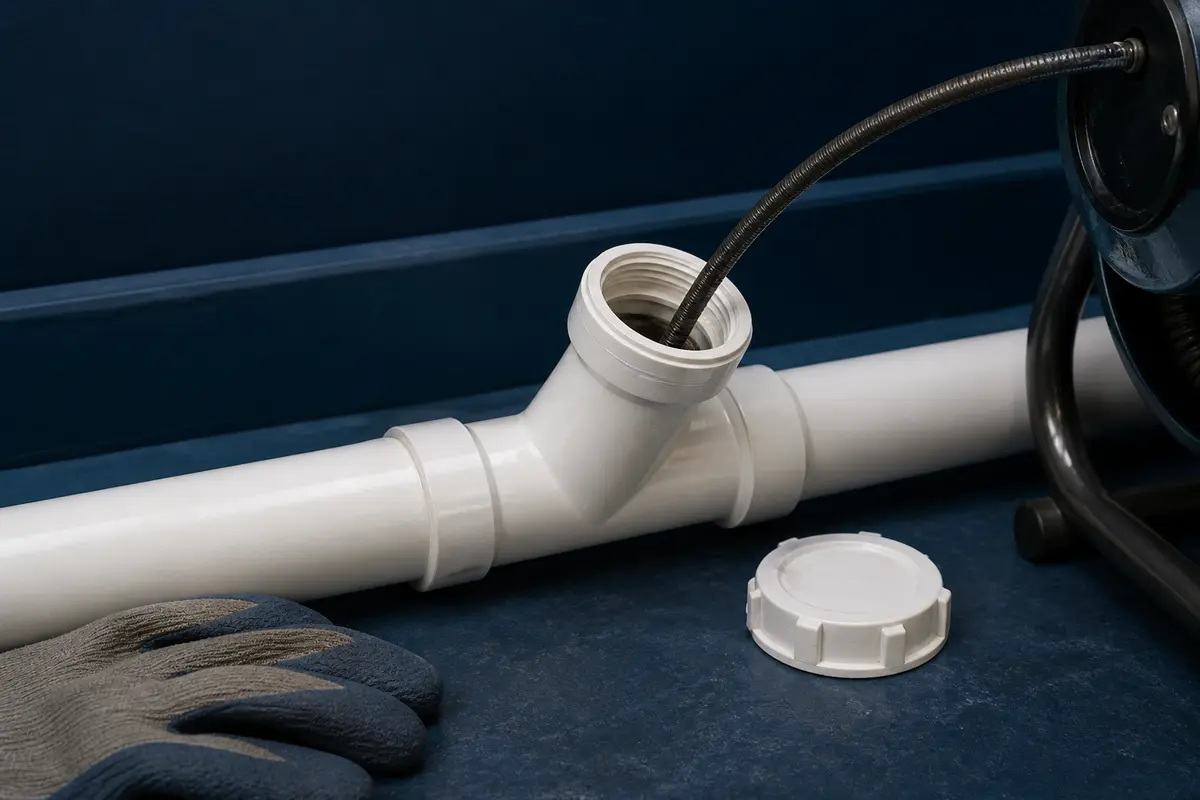
A slow or blocked drain is one of the most common household plumbing problems — and usually one of the most fixable. This page explains what drain cleaning actually involves, why drains clog, how a professional figures out what is wrong, and what you can do to keep your pipes flowing. It is written for homeowners in Montgomery County, Pennsylvania, to help you understand the service before you pick up the phone. It does not recommend a specific contractor or quote a price.
What drain cleaning is
Drain cleaning is the work of removing blockages and buildup from the pipes that carry wastewater out of your home: the drains under your kitchen and bathroom sinks, your tub and shower, your toilet, and the main sewer line connecting your house to the municipal sewer system.
The defining feature is restoring flow — clearing an obstruction so water moves again. That is different from emergency plumbing (a burst pipe, or sewage actively flooding a home) and different from pipe repair or replacement. In practice the two often meet: a drain-cleaning visit can reveal that what looked like a simple clog is actually a cracked pipe, a root intrusion, or a collapsed section that needs repair rather than clearing.
When homeowners usually seek help
Most people call when they notice one or more of these:
- Slow drainage — water pools in a sink, tub, or shower and takes noticeably longer to go down.
- Recurring clogs — the same drain keeps blocking even after you clear it.
- Gurgling sounds — bubbling from a drain when water runs or a toilet flushes.
- Several drains backing up at once — when multiple fixtures act up together, the problem is often in the main line rather than a single fixture.
- Water or sewage coming back up — through a floor drain, tub, or toilet.
- A persistent odor — a sewage or musty smell that does not go away.
A single slow fixture usually points to a localized clog. Multiple affected fixtures, or a sewage smell, point toward a main-line problem and a stronger reason to bring in a professional.
Common signs and causes
The most common causes of household drain clogs are well documented, and most are preventable.
- Fats, oils, and grease (FOG). Cooking fats cool and harden inside pipes, building up over time. Grease from homes, restaurants, and industrial sources is the most common cause of reported sewer blockages, at roughly 47% (EPA SSO FAQ; Clemson HGIC; City of Raleigh). That figure is a national estimate attributed to the EPA, not a Montgomery County statistic — but the underlying habit of pouring grease down the drain is the same everywhere.
- “Flushable” wipes and other non-flushables. Wipes (even ones labeled “flushable”), paper towels, dental floss, and similar items do not break down the way toilet paper does. They snag and accumulate in household and municipal lines (EPA SSO FAQ; City of Albany, OR).
- Tree roots. Roots can enter a sewer line through small defects, joints, or openings and grow into a mass that traps debris (EPA SSO FAQ).
- Hair and soap scum. In bathroom drains, hair binds with soap residue to form stubborn clogs.
- Food waste and debris. Coffee grounds, eggshells, and fibrous scraps belong in the trash, not the drain.
- Mineral buildup. Where water is hard, scale can narrow pipes over time.
These are general failure modes, not a diagnosis of any specific home. The only way to know what is actually blocking your line is to look — which is what the next section covers.
How professionals diagnose the problem
A plumber typically works through a few steps:
- Confirm the scope. Which fixtures are affected, and is the problem localized to one drain or spread across the main line?
- Clear the immediate blockage. This restores flow so the home is usable again.
- Investigate when needed. If the clog is recurring or the cause is unclear, the plumber may run a camera through the line to see inside the pipe and identify roots, cracks, offsets, or collapsed sections.
Diagnosis is site-specific. A good contractor will tell you whether you are dealing with a simple clog or a structural problem, and what your options are either way.
Common service and repair paths
Drain-cleaning work generally falls into a few categories:
- Augering / snaking. A motorized or hand-cranked cable with a cutting head is fed through the drain to break up or retrieve the clog. This is the most common first-line method for localized clogs.
- Hydro-jetting. High-pressure water scours buildup — grease, scale, and sometimes roots — from the pipe walls. It is often used for main lines and for recurring grease or scale problems.
- Camera inspection. A small camera locates the blockage and assesses pipe condition. It is frequently used before or after clearing to confirm the cause.
- Toilet auger. A shorter tool with a protective sleeve, used specifically for toilets to avoid damaging the porcelain.
These are general service categories. Which method fits, and whether clearing alone is enough or repair is needed, depends on your specific pipe, its condition, and local code. These descriptions come from general home-improvement and contractor education sources and are used here only to explain the landscape — not as technical instructions.
What affects the scope of the job
Several factors change how involved a drain-cleaning job becomes. None of them translate into a fixed price, and this page makes no cost or savings claims.
- Where the blockage is — a single fixture versus the main sewer line.
- What is causing it — a soft clog versus grease or scale buildup versus root intrusion versus a structural defect such as a crack, offset, or collapse.
- Access — whether a cleanout is present and reachable, or whether the plumber must remove a fixture or work from a roof vent.
- Pipe condition and age — older or damaged pipe may not tolerate aggressive methods and may need repair instead of cleaning.
- Recurrence — a clog that returns quickly often signals an underlying issue (roots, a sag or “belly” in the line, or a broken section) that cleaning alone will not fix.
- Depth and length — how far down the line the problem sits, and how much of the line is affected.
Because these factors vary so much between jobs, any real estimate has to come from a written quote for your specific situation — which makes the questions below worth asking up front.
Questions to ask a contractor
- Are you registered as a Pennsylvania Home Improvement Contractor (HIC), and do you hold any municipal plumbing license or registration required where I live? (These are separate things — see the Montgomery County section below.)
- Will you diagnose the cause, or only clear the immediate clog?
- Do you use a camera inspection, and will you show me what it found?
- Is this a clog, or is there pipe damage that needs repair? What are my options if cleaning alone will not fix it?
- Is there a cleanout on my property, and will you use it?
- What method do you recommend for my situation, and why?
- What is included in the written estimate, and what would trigger additional work or cost?
- Do you guarantee the work, and what does the guarantee cover?
The key decision points are whether to clear only versus investigate further, whether a recurring clog warrants a camera inspection, and whether root intrusion calls for a longer-term plan — root treatment or pipe repair — rather than repeated clearing.
If you already know the service you need, you can compare published drain-cleaning listings in the directory.
Maintenance and prevention
The most effective prevention is keeping the most common clog-causing materials out of your drains in the first place.
- Keep FOG out of drains. Pour cooled fats, oils, and grease into a container and put it in the trash; wipe greasy pans with a paper towel before washing (EPA SSO FAQ; City of Raleigh; Clemson HGIC).
- Do not flush wipes or non-flushables. Wipes (even “flushable” ones), paper towels, and dental floss belong in the trash, not the toilet (EPA SSO FAQ; City of Albany, OR).
- Use drain strainers. Catch hair and food debris in sinks, tubs, and showers.
- Scrape plates into the trash. Keep food scraps out of the drain.
- Run hot water after use. A brief hot-water flush can help move soap and grease residue along. This is general guidance, not a substitute for proper FOG disposal.
- Know your sewer responsibility. Understand which portion of the sewer line you are responsible for maintaining (see the Montgomery County section).
These habits reduce the most common causes of clogs, but they are not a guarantee. They do nothing about tree-root or structural problems.
Safety boundaries
- Chemical drain cleaners. Caustic and acidic chemical drain cleaners can burn skin and eyes, release harmful fumes, and damage pipes. EPA household-hazardous-waste guidance recommends a plunger or a plumber’s snake instead (EPA HHW; Poison Control). If you have already used a chemical cleaner, tell the plumber before any work begins.
- Sewage exposure. Sewage can carry bacteria, viruses, and parasites (EPA SSO FAQ). A significant sewage backup is professional remediation work. Basic protection — rubber gloves, boots, and eye protection — is the limit of what this page advises for a homeowner.
- Do not attempt main-line or structural work yourself. Main sewer line clearing, root removal, and pipe repair are professional jobs.
- Stay away from hazards. Do not work on gas lines or energized equipment, and do not enter standing water near electricity.
This page does not promise response times, outcomes, cost savings, code compliance, or contractor availability.
Montgomery County considerations
A few local points matter here, and some require checking with your own municipality.
- Sewer oversight is municipal. In Pennsylvania, the design, permitting, installation, operation, and maintenance of sewerage facilities are the responsibility of each municipality and the Pennsylvania Department of Environmental Protection (DEP). Montgomery County’s role is advisory (Montgomery County planning page). The relevant sewer authority — and the rules that apply to you — therefore vary by municipality.
- You may be responsible for part of your sewer line. Homeowners may be responsible for maintaining and repairing a portion of the sewer line serving their property. The exact split between homeowner and authority is set by the local sewer authority — for example, the Montgomery Township Municipal Sewer Authority. Confirm this with your own authority.
- HIC registration is not a plumbing license. Pennsylvania does not issue a single statewide plumbing license. Contractors doing $5,000 or more per year of residential home-improvement work must register as a Home Improvement Contractor (HIC) with the Pennsylvania Office of Attorney General. That registration is a consumer-protection requirement, not a plumbing license (PA AG; PA DLI). Whether your municipality requires a separate plumbing license or master-plumber registration varies and should be verified locally.
- Permit triggers vary. Which drain-cleaning or sewer-repair jobs trigger a plumbing permit or inspection under the Pennsylvania Uniform Construction Code varies by municipality and is not stated here.
- Local utility contacts. The correct water and sewer authority emergency and contact numbers depend on your address and are not listed here.
Because these details differ from one municipality to the next, this page is a county-level overview. It does not substitute for checking the rules that apply to your specific address.
Sources
- U.S. EPA — Sanitary Sewer Overflow (SSO) Frequent Questions — https://www.epa.gov/npdes/sanitary-sewer-overflow-sso-frequent-questions
- U.S. EPA — Sanitary Sewer Overflows (SSOs) — https://www.epa.gov/npdes/sanitary-sewer-overflows-ssos
- U.S. EPA — Household Hazardous Waste (HHW) — https://www.epa.gov/hw/household-hazardous-waste-hhw
- Poison Control (poison.org) — What’s in drain cleaner and what happens if you drink it? — https://www.poison.org/articles/whats-in-drain-cleaner
- Clemson HGIC — F.O.G. (Fats, Oils, and Grease) Pollution — https://hgic.clemson.edu/factsheet/f-o-g-fats-oils-and-grease-pollution
- City of Raleigh, NC — Fats, Oils, and Grease Stormwater Pollution — https://raleighnc.gov/stormwater/services/spot-report-and-stop-water-pollution/fats-oils-and-grease-stormwater-pollution
- City of Albany, OR — “Flushable” Wipes Clog Pipes — https://albanyoregon.gov/pw/wastewater/wipes
- Montgomery Township Municipal Sewer Authority — What portion of pipe am I responsible for? — https://www.mtmsa.org
- Montgomery County, PA — Water Supply & Sewage Disposal Planning — https://www.montgomerycountypa.gov/departments/planning-commission/planning-topic/programs-initiatives/environmental-planning/water-supply-sewage-disposal-planning
- Pennsylvania Office of Attorney General — Home Improvement Contractor Registration — https://www.attorneygeneral.gov/businesses-and-organizations/home-improvement-contractor-registration/
- Pennsylvania Department of Labor & Industry — Uniform Construction Code (UCC) — https://www.pa.gov/agencies/dli/programs-services/labor-management-relations/bureau-of-occupational-and-industrial-safety/uniform-construction-code-home
- This Old House — How to Snake a Clogged Drain — https://www.thisoldhouse.com/bathrooms/how-to-snake-a-clogged-drain
- Roto-Rooter — What to Expect During a Water Jetting Service — https://www.rotorooter.com/blog/plumbing/what-to-expect-during-water-jetting-service
Related video
Fats, oils, grease and ‘flushable’ wipes are wreaking havoc on city pipes
A municipal public-works video shows why grease and so-called flushable wipes are common preventable causes of drain and sewer clogs.
Video: Fats, oils, grease and ‘flushable’ wipes are wreaking havoc on city pipes — City of Havre de Grace.
Context and limits: The examples are from Maryland; use the prevention principle as general education, not as Montgomery County system guidance.