The sewer line — called the sewer lateral or service line — is the underground pipe that carries every drop of wastewater from your home to the municipal sewer main. When something goes wrong underground, you usually find out fast: through a backup, a sewage smell, or a soggy patch of lawn. This page explains what sewer-line work involves, how professionals diagnose it, what the common repair paths look like, and what to ask a contractor before signing anything. It is written for homeowners in Montgomery County, Pennsylvania, to help you understand the service before you call — not to recommend a specific contractor or promise a specific price.
What sewer-line work is (and isn’t)
The sewer lateral runs from your house to the public sewer main. Depending on where you live, you may own and maintain part or all of it.
Sewer-line work covers anything that involves assessing or fixing that pipe:
- A sewer scope (camera inspection) to see inside the pipe and locate a problem.
- Spot repair of a single damaged section.
- Full replacement of the lateral, by excavation or trenchless method.
- Root treatment to clear roots when the pipe itself is still sound.
It is different from drain cleaning (clearing a blockage to restore flow) and from emergency plumbing (a burst pipe or sewage actively flooding your home). In practice the three meet often: a drain-cleaning visit can turn into a sewer-line job the moment the camera reveals a crack, a root mass, or a collapsed section. The defining question is whether the pipe itself needs work — not just whether water is moving again.
Warning signs that point to a sewer-line problem
You rarely start thinking about the sewer line because of the pipe itself. You start because something is misbehaving above ground:
- Recurring or multiple-drain backups. A single slow fixture is usually a local clog. Several fixtures backing up at once — or a main-line clog that keeps returning — points to something structural in the lateral.
- Sewage backing up into the home. Water or sewage coming up through a floor drain, tub, or toilet. Urgent, and a public-health concern.
- Gurgling or bubbling sounds. Drains that gurgle when water runs or a toilet flushes often mean air is trapped downstream.
- Whole-house slow drainage. When every fixture drains slowly at once, the bottleneck is in the main line.
- Persistent odor or wet yard. A sewage smell, or a soggy, unusually green patch of lawn over the line, can mean a leak.
- Yard depressions or sinkholes. A sunken strip over the lateral can indicate a collapsed or offset section.
- A real-estate transaction. Buyers or sellers sometimes order a sewer scope before closing so a hidden defect does not become the new owner’s first-week emergency.
When several of these show up together — backups plus odor plus a wet spot in the yard — it is reasonable to skip DIY attempts and call a professional.
Common causes
Sewer-line failures come from a small set of well-documented causes. None of these is a diagnosis for any specific home, but they help you read a contractor’s report when you get one:
- Tree-root intrusion. Roots enter through joints, cracks, or small openings and grow into a mass that traps debris and can crack the pipe further. The U.S. Environmental Protection Agency lists tree roots entering through defects or openings as a recognized cause of sewer blockages (EPA SSO FAQ).
- Fats, oils, and grease (FOG). Cooking fats, oils, and grease cool and solidify inside the pipe, building up on the walls over time. FOG is a recognized cause of sewer blockages (EPA SSO FAQ).
- “Flushable” wipes and other non-flushables. Wipes — even those labeled “flushable” — paper towels, dental floss, and similar items do not break down like toilet paper. They snag and accumulate, especially where the line already has rough spots or roots (EPA SSO FAQ).
- Age and material deterioration. Older clay, cast-iron, or Orangeburg pipe can crack, corrode, or collapse over time. Some materials used in past decades fail earlier than modern PVC or HDPE.
- Bellies or sags. A section of pipe that has settled and now holds standing water, which collects debris and eventually blocks the line.
- Offsets or separated joints. Pipe sections that have shifted out of alignment, often from ground movement or settling. Debris catches on the lip and builds up.
- Ground movement. Freeze-thaw cycles, settling soil, or nearby construction can shift or break the lateral.
These are general failure modes. The only way to know what is actually wrong with your line is to look.
How professionals diagnose the problem
A sewer-line visit usually follows a few steps:
- Confirm the scope. Which fixtures are affected, and is the problem localized or in the main line?
- Clear any immediate blockage if needed. This restores flow so the home is usable again.
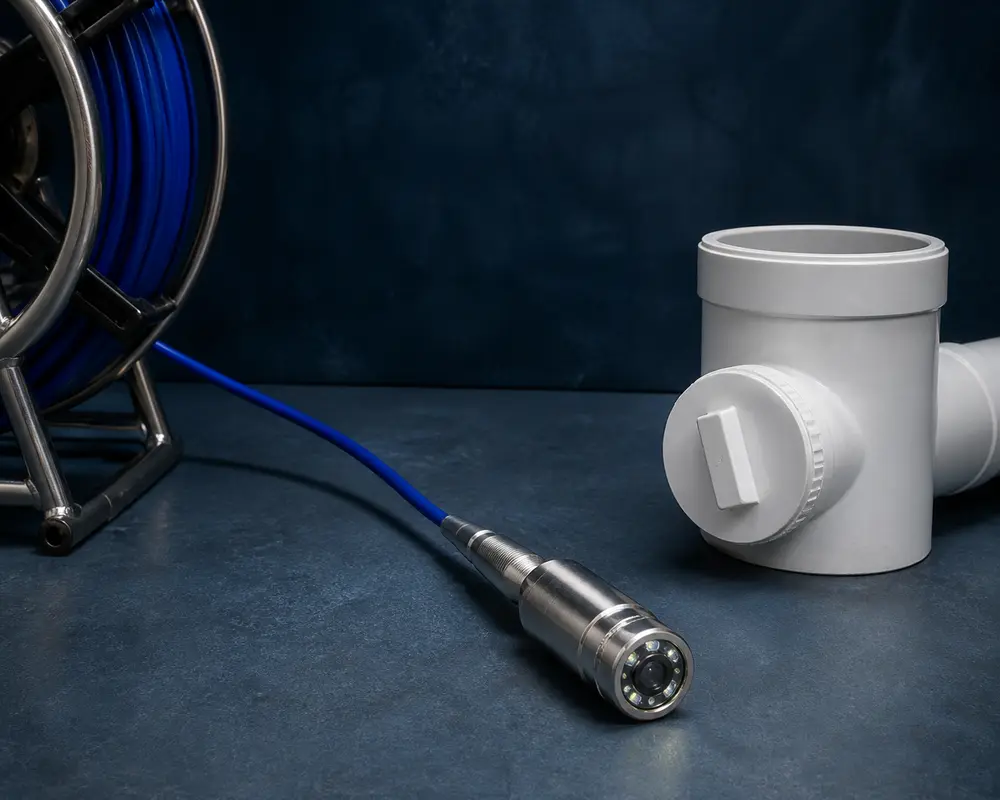
- Run a camera. A small camera on a flexible cable is fed through the line so the plumber can see roots, cracks, offsets, bellies, or collapsed sections.
A camera inspection is the standard way to tell whether the problem is a clog or a structural defect, and to locate the defect precisely so any repair can be targeted (Montgomery Township Municipal Sewer Authority; City of Portland BES). What the camera shows is site-specific — a clean PVC line and a root-filled clay line call for very different plans. Diagnosis is the plumber’s job; the inspection’s value is that everyone works from the same picture of what is underground.
Common service and repair paths
Sewer-line work generally falls into a few categories. The right one depends on what the camera shows, what the pipe is made of, what the access is like, and what your municipality will allow.
- Camera inspection (sewer scope). A camera run through the line to locate the problem and assess pipe condition. Often the first step in a real-estate transaction and the first step after a recurring main-line clog.
- Spot repair. Excavating down to a single damaged section and replacing just that piece. Useful when the rest of the line is in good condition and the damage is localized.
- Full open-cut replacement. Excavating a trench the length of the lateral, removing the old pipe, and laying new pipe. Sometimes the only option when the existing pipe is too damaged for trenchless methods.
- Trenchless rehabilitation — cured-in-place pipe (CIPP) lining. A resin-saturated liner is inserted into the existing pipe and cured in place to form a new pipe within the old one. It addresses cracks, leaks, and corrosion without a full trench (NASSCO).
- Trenchless replacement — pipe bursting. A new pipe is pulled through the old one, fracturing the old pipe outward. The lateral is replaced without excavating the full length (NASSCO).
- Root treatment. Mechanical cutting or chemical root control to clear an active root mass. Often a temporary measure when the pipe is still structurally sound; recurring root problems usually point toward eventual repair or replacement.
These are general categories. Suitability depends on pipe condition, length, the number of bends, and local conditions. None of these descriptions is a recommendation for any specific home; the right method is the one your camera, your pipe, and your municipality agree on.
What affects the scope of the job
Sewer-line work varies a lot in size and difficulty. None of the factors below turns into a fixed price, and this page makes no cost, savings, or timeline claims:
- Location and depth of the problem. How far down the lateral the issue sits and how deep the pipe is buried.
- Cause and extent of damage. A single crack versus root intrusion versus a collapsed or offset section versus a full-length deteriorated line.
- Pipe material and age. Older or weak materials (Orangeburg, aging clay, badly corroded cast iron) push the answer toward replacement rather than spot repair.
- Access. Whether the lateral runs under a driveway, sidewalk, mature landscaping, or a structure, and whether a cleanout is already in place.
- Repair method. Open-cut excavation versus trenchless (CIPP lining or pipe bursting). Trenchless avoids most of the digging but depends on pipe condition and may not be appropriate for every situation.
- Length of the lateral and permits. A short spot repair versus a full-length replacement is a very different project, and whether the municipality requires a plumbing permit adds another variable (see Montgomery County considerations).
Because these factors change from one home to the next, any real estimate has to come from a written quote for your specific situation.
Questions to ask a contractor
Sewer-line work is a significant project. A few questions can help you understand what you are getting into:
- Are you registered as a Pennsylvania Home Improvement Contractor (HIC), and do you hold any municipal plumbing license or registration required where I live? (These are separate things — see Montgomery County considerations.)
- Based on the camera, is the problem a clog, or is there pipe damage that needs repair or replacement?
- What are my options — spot repair, full replacement, or trenchless — and which do you recommend for my situation, and why?
- Is trenchless repair appropriate for my pipe, or does the condition require open-cut excavation?
- What is included in the written estimate, and what would trigger additional work or cost?
- Do you handle the permit and any required inspection, or is that my responsibility?
- Do you guarantee the work, and what does the guarantee cover and for how long?
The big decision points are usually whether to repair or replace, whether trenchless is viable, and whether recurring root problems call for a longer-term plan instead of repeated clearing.
Maintenance and prevention
Sewer-line work is largely reactive, but a few habits reduce the most common causes:
- Keep FOG out of drains. Pour cooled fats, oils, and grease into a container and put it in the trash; wipe greasy pans with a paper towel before washing (EPA SSO FAQ).
- Do not flush wipes or non-flushables. Wipes (even “flushable” ones), paper towels, dental floss, and similar items belong in the trash, not the toilet (EPA SSO FAQ).
- Think before you plant. Tree roots seek out sewer lines. Where you plant a tree matters, especially over an older lateral.
- Know your sewer responsibility. Find out from your local sewer authority which portion of the lateral you own and maintain.
- Consider a sewer scope before buying. A camera inspection during a real-estate transaction can reveal a hidden defect before it becomes your first-week emergency.
These habits reduce the most common causes of failure. They do not eliminate age-related deterioration, ground movement, or roots that have already found a way in.
Safety boundaries
A few safety points are worth stating plainly:
- Sewage exposure. Sewage can carry bacteria, viruses, protozoa, and other pathogens and can cause illness (EPA SSO FAQ). A significant sewage backup is professional remediation work. Basic protection — rubber gloves, boots, eye protection, and a respirator or mask — is the limit of what this page advises for a homeowner (NDSU extension).
- No DIY on the sewer line itself. Excavating, cutting, lining, or replacing a sewer lateral is licensed and registered professional work. This page does not provide instructions for it.
- Stay away from hazards. Do not work on gas lines or energized equipment, and do not enter standing water near electricity.
- Be careful with chemical drain cleaners. Caustic and acidic chemical drain cleaners can burn skin and eyes, release harmful fumes, and damage pipes. They are not a fix for sewer-line problems, and they can make a plumber’s work harder and more dangerous.
This page does not promise response times, outcomes, cost savings, code compliance, or contractor availability. Any of those has to come from a specific, written agreement for your situation.
Montgomery County considerations
Local context matters for sewer-line jobs in Montgomery County, and several pieces of it vary by municipality:
- Sewer oversight is municipal. In Pennsylvania, design, permitting, installation, operation, and maintenance of sewerage facilities are the responsibility of each municipality and the Pennsylvania Department of Environmental Protection (DEP). Montgomery County’s role is advisory (Montgomery County planning page; PA DEP Act 537). The relevant sewer authority and the rules that apply to you depend on where you live.
- You may own part of the lateral. The exact split between homeowner and authority is set by the local sewer authority. The Montgomery Township Municipal Sewer Authority, for example, states that the property owner is generally responsible for the entire service line from the building to the public sewer main (MTMSA). Confirm the split with your own authority.
- HIC registration is not a plumbing license. Pennsylvania does not issue a single statewide plumbing license. Contractors doing $5,000 or more per year of residential home-improvement work must register as a Home Improvement Contractor (HIC) with the Pennsylvania Office of Attorney General. That registration is a consumer-protection requirement, not a plumbing license, and is not an endorsement of competency (PA Attorney General; PA Department of Labor & Industry). Whether your municipality requires a separate plumbing license or master-plumber registration varies and should be verified locally.
- Permits and code vary. Which sewer-line jobs trigger a plumbing permit or inspection under the Pennsylvania Uniform Construction Code varies by municipality, as does the exact plumbing code in force. A permit may be required even for trenchless work, depending on local rules.
- Utility contacts vary. The correct water and sewer authority emergency and contact numbers depend on your address and are not listed here.
Because these details differ from one municipality to the next, this page is a county-level overview. It does not substitute for checking the rules that apply to your specific address with your municipality and your sewer authority.
Sources
- U.S. EPA — Sanitary Sewer Overflow (SSO) Frequent Questions — https://www.epa.gov/npdes/sanitary-sewer-overflow-sso-frequent-questions
- U.S. EPA — Sanitary Sewer Overflows (SSOs) — https://www.epa.gov/npdes/sanitary-sewer-overflows-ssos
- Montgomery Township Municipal Sewer Authority — What portion of pipe am I responsible for? — https://www.mtmsa.org/what-portion-pipe-am-i-responsible
- Pennsylvania Office of Attorney General — Home Improvement Contractor Registration — https://www.attorneygeneral.gov/businesses-and-organizations/home-improvement-contractor-registration/
- Pennsylvania Department of Labor & Industry — Contractor Licensing (Uniform Construction Code) — https://www.pa.gov/agencies/dli/programs-services/labor-management-relations/bureau-of-occupational-and-industrial-safety/uniform-construction-code-home/contractor-licensing
- Pennsylvania DEP — Public and Private Sewer Systems (Act 537 Sewage Facilities Program) — https://www.pa.gov/agencies/dep/programs-and-services/water/clean-water/wastewater-management/act-537-sewage-facilities-program/public-and-private-sewer-systems
- Montgomery County, PA — Water Supply & Sewage Disposal Planning — https://www.montgomerycountypa.gov/departments/planning-commission/planning-topic/programs-initiatives/environmental-planning/water-supply-sewage-disposal-planning
- NASSCO — Pipe Rehabilitation (CIPP, pipe bursting) — https://www.nassco.org/trenchless-technology/rehabilitation/pipe-rehabilitation/
- City of Portland, OR (Bureau of Environmental Services) — Sewer Video, Photo, and Map Guidelines — https://www.portland.gov/bes/connecting-sewer/sewer-photo-video-map
- North Dakota State University Extension — Cleaning Sewage Backup — https://www.ndsu.edu/agriculture/ag-hub/cleaning-sewage-backup
Related video
How a Sewer Camera Inspection Works
This contractor-produced demonstration helps homeowners visualize the camera-inspection step used to locate and document sewer-line problems.
Video: How a Sewer Camera Inspection Works — Reliant Plumbing.
Context and limits: The publisher sells plumbing services. The video illustrates a process but does not establish the diagnosis, repair method, or contractor choice for a Montgomery County property.