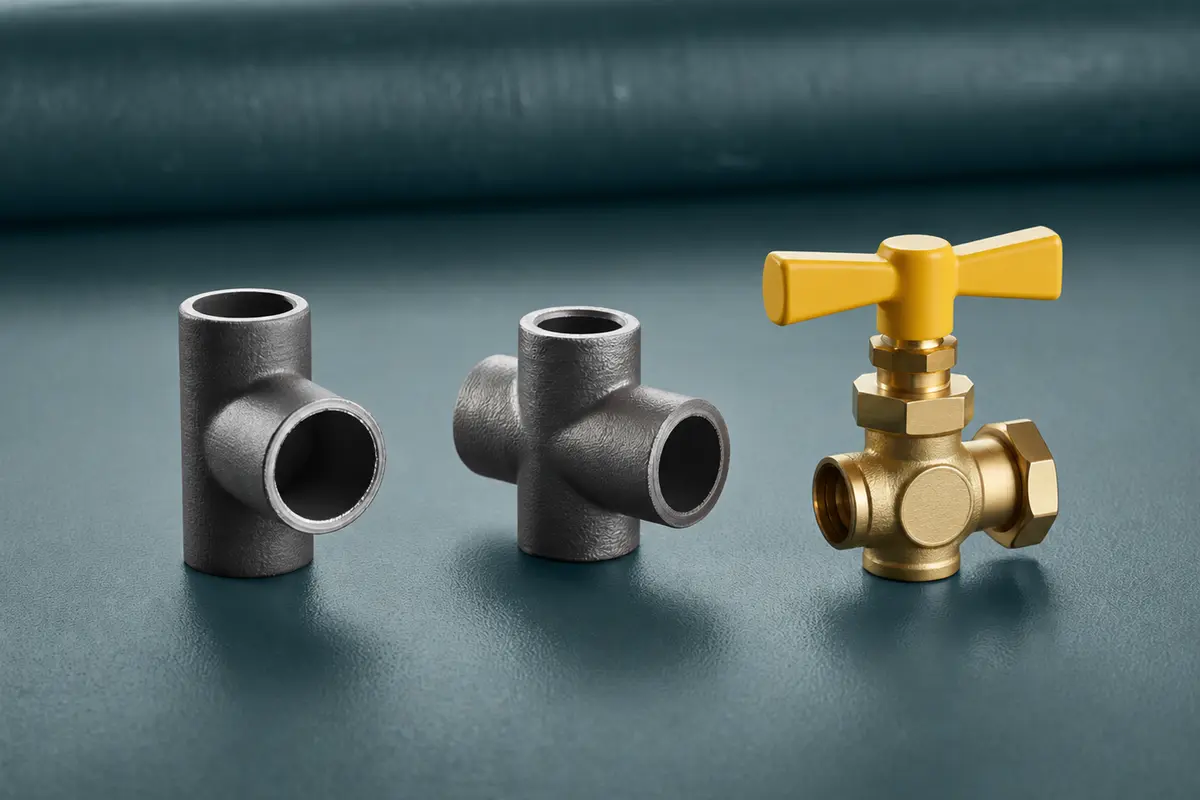
Gas line plumbing is the work of installing, repairing, testing, and maintaining the pipes, fittings, valves, and connections that carry natural gas from the meter into and around a home — to furnaces, water heaters, ranges, dryers, fireplaces, pool heaters, and standby generators. This page is written for Montgomery County, Pennsylvania homeowners who want to understand what gas line service covers, when it is needed, what the safety rules are, and what belongs in the hands of a qualified professional. It does not promise outcomes, response times, savings, or rankings, and it does not recommend specific contractors.
If you smell gas right now: leave the building immediately. Do not flip switches, use a phone, light a match, or start a car. Once you are outside and away from the building, call PECO at 1-800-841-4141 and/or 911. Do not return until PECO or emergency responders say it is safe. (Source: PECO Natural Gas Safety; APGA Natural Gas Safety.)
What gas line plumbing is — and who owns what
There is a clean dividing line in every gas-connected home, and it matters for who you call and who pays.
The ownership line. PECO, the natural gas utility serving most of Montgomery County, owns and maintains the service line and the gas meter — everything up to and including the meter. The homeowner owns everything downstream of the meter, called “customer-owned” gas piping, and is responsible for its condition, maintenance, and repair. (Sources: PECO Natural Gas Safety; CGS Energy, Customer-Owned Gas Piping; APGA Natural Gas Safety.)
What professional gas line plumbing typically covers:
- Running a new gas line to connect an appliance (range, dryer, water heater, fireplace, pool heater, or generator)
- Extending an existing line to a new location (garage, shed, or outdoor kitchen)
- Repairing or replacing pipe that is corroded, damaged, or past its useful life
- Pressure testing the system to confirm it holds pressure without leaking
- Investigating and repairing leaks
- Replacing gas valves and shut-offs
- Relighting pilots and restarting appliances after service
- Capping and decommissioning a line when an appliance is removed
- Installing and bonding corrugated stainless steel tubing (CSST)
- Tracing and repairing buried gas lines
What this service does not include: meter turns, utility-side line damage, and emergency response on PECO’s side of the meter are PECO’s responsibility, not the plumber’s.
When homeowners usually seek this service
Gas line calls fall into two very different categories: emergencies and planned work.
Emergency — leave and call, do not investigate:
- A rotten-egg or sulfur smell near an appliance, in a room, or outdoors near the meter
- A hissing, whistling, or roaring sound near a gas pipe, connection, or the meter
- Dead or dying vegetation in an isolated patch over a buried line
- A carbon monoxide alarm sounding, or flu-like symptoms that ease when you leave the house
- Visible damage to a pipe or fitting
- A pilot light that keeps going out, or a yellow or orange flame with soot on a gas appliance (Sources: Constellation Energy; APGA Natural Gas Safety; PECO Natural Gas Safety.)
Planned — schedule a professional:
- Installing a new gas appliance
- Running gas to a new part of the home or an outbuilding
- Replacing an aging or corroded section of pipe
- Converting from propane to natural gas (or the reverse)
- Adding a gas log or fireplace insert
- Replacing a furnace or water heater when the existing connection needs to change
- A pressure test required for a permit, a home sale, or a lender
A gas leak and a carbon monoxide problem are not the same thing. A gas leak is unburned fuel escaping from a pipe or fitting. Carbon monoxide (CO) is an odorless, colorless gas produced when fuel burns incompletely — usually because an appliance is not venting properly. Natural gas is odorized so you can smell a leak; CO has no smell at all. Both are serious, and both are reasons to evacuate and call for help. (Sources: CDC, Carbon Monoxide Poisoning Basics; PECO Natural Gas Safety.)
Common causes of gas line problems
Gas piping problems rarely appear out of nowhere. The most common failure modes:
- Corrosion and age. Older black iron pipe can corrode from the inside or outside over decades, especially in damp basements or where the pipe passes through concrete. Internal corrosion thins the pipe wall and can open a leak path.
- Mechanical damage. Excavation (even a small project like a fence post), foundation settling, or an accidental impact can crack or dent pipe. Buried lines are especially exposed.
- Fitting and joint failure. Threaded joints, welds, and compression fittings can degrade over time, particularly if they were assembled with the wrong materials or technique.
- CSST bonding problems. Corrugated stainless steel tubing — a flexible gas line option — can be damaged by lightning or an electrical fault if it is not properly bonded and grounded. Improper bonding is a known fire hazard. (Source: NFPA 54, National Fuel Gas Code.)
- Appliance connector wear. Flexible appliance connectors (a different product from CSST) can crack or deteriorate with age and movement.
- Odor fade. The mercaptan that gives natural gas its rotten-egg smell can become harder to detect under certain conditions — new steel pipe, intermittent flow, and some soil and pipe combinations. This is why smell alone is not a reliable leak detector. (Source: SoCalGas, Natural Gas Leaks.)
How professionals diagnose gas line work
A qualified gas professional works through a sequence rather than a single test. Diagnosis is site-specific; the right next step depends on what the inspection turns up.
- Visual inspection of accessible piping for corrosion, damage, and improper installation.
- Pressure testing — isolating the system and applying air or inert gas pressure, then watching for a pressure drop over a set period. NFPA 54 sets the test requirements for new work before it goes into service.
- Leak detection using electronic gas detectors, soap-bubble solution, or infrared imaging on suspect areas.
- Flow and pressure checks to confirm appliances are getting adequate gas.
- Combustion analysis on appliances to check for unsafe byproducts such as excess carbon monoxide or an improper flame.
- CSST bonding verification — confirming the tubing is bonded and grounded per the manufacturer’s instructions and NFPA 54. (Sources: NFPA 54; American Gas Association, 2021 National Fuel Gas Code Fact Sheet.)
Common service and repair paths
The categories a homeowner is most likely to encounter:
- Inspection and testing. Leak investigation, pressure testing, and system verification — including the pressure test NFPA 54 requires before new piping is placed into service.
- Repair. Cutting out and replacing a corroded or damaged section of pipe; renewing threaded joints, ball valves, and shut-offs; replacing damaged CSST and confirming its bonding; swapping aging appliance connectors.
- New installation. Running a new branch line to an appliance; completing rough-in and final connection for a range, dryer, fireplace, generator, or pool heater; installing buried exterior lines.
- Utility coordination. Meter turns and utility-side leak response are PECO’s work, not the plumber’s. Large excavation near a gas main may require PECO liaison or on-site presence.
What affects the scope of a project
The size and shape of a gas line job depends on the home and the equipment. Pricing should come from a written estimate, not from this page.
- Pipe material and routing. Black iron is the standard for most residential runs; CSST may be used for complex paths. Whether the pipe runs through a basement, walls, a crawl space, or underground changes the labor significantly.
- Appliance load. Each appliance has a BTU input rating, and the line must be sized to deliver enough gas. A high-demand appliance such as a pool heater or large generator may require a larger-diameter run.
- Distance from the existing header. Longer runs need more material and labor, and may require upsizing to hold pressure.
- Permits and inspections. New installations and significant changes typically require a permit and a final inspection, and the process varies by municipality.
- Underground work. Buried lines involve trenching, which triggers the 811 utility-locate requirement and may involve right-of-way permits.
- Appliance specifications. Each appliance has its own connection, clearance, and venting requirements.
- Condition of the existing system. Significant corrosion or non-compliant existing pipe can expand a repair into broader repiping.
- CSST bonding status. If the home has CSST without documented bonding, a bonding assessment or upgrade may be added.
- Access. Work in an unfinished basement is generally simpler than work in a finished basement, crawl space, or behind walls.
Questions to ask a contractor
A short list helps homeowners compare contractors on substance rather than price alone.
- Are you registered as a Pennsylvania Home Improvement Contractor, and do you hold any municipal plumbing or master-plumber registration required where I live? These are separate things — registration alone is not a license.
- Do you carry general liability and workers’ compensation insurance, and will you provide certificates?
- Do you have specific experience with gas line work, and can you point to recent gas line projects?
- Who obtains the permit for this work — you or me — and who schedules the required inspections?
- Do you pressure test and leak check after installation, and will I receive documentation?
- For CSST, will you verify and document proper bonding and grounding?
- What pipe material do you recommend for my situation, and why?
- Will you provide a written scope of work and itemized pricing before starting?
- Who is responsible for calling 811 before any excavation?
Maintenance and prevention
These practices are supported by utility, trade-association, and public-health guidance.
- Annual heating inspection. PECO recommends having the heating system (furnace, boiler, and water heater) inspected annually before the heating season begins.
- Periodic piping inspection. Have a qualified professional inspect accessible gas piping for corrosion, damage, and wear, especially in homes with piping more than 20 years old.
- Call 811 before digging. Pennsylvania law requires calling 811 at least 3 business days (and no more than 10 business days) before any excavation — fence posts, deck footings, tree planting, or concrete work. The locate service is free. (Sources: PA One Call; PA PUC, PA One Call; APGA Natural Gas Safety.)
- If a line is struck. If a gas line is hit or damaged — even with no odor — stop work, evacuate the area, and call 911 and PECO from a safe distance.
- Carbon monoxide and methane detectors. Install CO detectors on every level and near sleeping areas. Replace batteries when the clocks change, and replace the units per the manufacturer’s instructions. CO detectors and methane detectors are not the same: a CO detector senses carbon monoxide from incomplete combustion, while a methane detector senses unburned natural gas. Homes with gas appliances benefit from both. (Sources: CDC, Carbon Monoxide Poisoning Basics; PECO Natural Gas Safety.)
- Appliance care. Have gas appliances serviced annually, keep vents and combustion-air intakes clear of snow, ice, debris, and nests, and never use a range or oven as a room heater.
- Meter area care. Keep the meter clear of snow, ice, landscaping, and stored items. Clear it gently with a broom — not a shovel or ice pick — and keep fertilizers and chemicals away to prevent corrosion.
Safety boundaries
Gas line work is not a do-it-yourself project. These are hard rules, not suggestions.
If you smell gas:
- Leave immediately — do not stay to investigate, open windows, or “check” anything.
- Do not operate switches, appliances, phones, doorbells, or anything that could spark.
- Do not use matches, lighters, or any open flame.
- Do not start or stop motorized equipment.
- From outside and away from the building, call PECO at 1-800-841-4141 and/or 911.
- Do not re-enter until PECO or emergency responders say it is safe.
What homeowners must not attempt:
- Do not try to locate a leak yourself using flame, smoke, or any method that could ignite gas.
- Do not repair, cap, or modify any gas pipe without proper training, tools, and permits.
- Do not use a gas pipe as an electrical ground or attach anything electrical to it.
- Do not modify or move the gas meter — only PECO-authorized personnel may work on it.
- Do not run gas pipe inside a building without permits and inspection.
- Do not install CSST without proper bonding and grounding.
- Do not repeatedly relight a pilot that keeps going out — that can signal a valve or safety-control problem that needs a professional.
Appliance and excavation safety:
- Never use a gas range or oven for home heating, and never burn charcoal or unvented fuel-burning appliances indoors.
- Ensure gas appliances are vented properly, and treat a yellow or orange flame with soot as a sign of incomplete combustion.
- Pennsylvania law requires calling 811 before digging. If you strike a buried line, leave immediately and call 911 and PECO from a safe distance.
Montgomery County considerations
Pennsylvania does not issue a single statewide plumbing license. The PA Department of Labor & Industry confirms that the Commonwealth has no statewide contractor license requirement and that municipalities may impose their own licensing. The honest answer to “what license or permit applies in my town” is: it depends on the municipality, and the homeowner should confirm with the local building or code-enforcement office before scheduling work.
The same is true for permits and inspections. Whether a specific gas line project requires a permit, and which office performs the inspection, varies across Montgomery County’s boroughs and townships. The National Fuel Gas Code (NFPA 54, current edition 2024) is the primary consensus standard for fuel gas piping, but it is adopted with state and local amendments, and this page does not verify any specific municipal amendment.
Two things are consistent across the county: PECO is the gas utility for most of the area, and the emergency number is 1-800-841-4141. PECO’s ongoing infrastructure work — the utility reports completing 292 projects and replacing nearly 329,000 feet of gas main in 2024 — is a reminder that the utility side is actively maintained, while the customer-owned side remains the homeowner’s responsibility. (Sources: PA Department of Labor & Industry, Contractor Licensing; NFPA 54; PECO Connection, Winter Natural Gas Safety Tips.)
Sources
- NFPA 54 — National Fuel Gas Code: https://www.nfpa.org/codes-and-standards/nfpa-54-standard-development/54
- PECO — Natural Gas Safety: https://www.peco.com/SafetyCommunity/Safety/Pages/NaturalGasSafety.aspx
- PECO Connection — Winter Natural Gas Safety Tips: https://www.pecoconnection.com/2024/12/03/winter-natural-gas-safety-tips/
- Cheltenham Township — PECO Winter Natural Gas Safety: https://www.cheltenhamtownship.org/newsview.aspx?nid=6492
- CDC — Carbon Monoxide Poisoning Basics: https://www.cdc.gov/carbon-monoxide/about/index.html
- American Public Gas Association — Natural Gas Safety: https://www.apga.org/natural-gas-safety
- PA Department of Labor & Industry — Contractor Licensing: https://www.pa.gov/agencies/agencies/dli/programs-services/labor-management-relations/bureau-of-occupational-and-industrial-safety/uniform-construction-code-home/contractor-licensing
- Pennsylvania One Call System (811): https://www.pa1call.org/
- PA Public Utility Commission — PA One Call: https://www.puc.pa.gov/pipeline-safety/pa-one-call/
- SoCalGas — Natural Gas Leaks (odorant and odor fade): https://www.socalgas.com/safety/safety-and-prevention/natural-gas-leak
- Constellation Energy — Natural Gas Leak Symptoms and Signs: https://www.constellation.com/energy-101/home-natural-gas-safety-tips.html
- CGS Energy — Customer-Owned Gas Piping: https://www.cgsenergy.org/Safety/Customer-Owned-Gas-Piping
- American Gas Association — 2021 National Fuel Gas Code Fact Sheet: https://www.aga.org/research-policy/resource-library/11602/
- Upper Moreland Township — PECO Contact Information: https://www.uppermoreland.org/294/PECO-Contact-Information
Related video
PECO: Natural Gas Safety
The local gas utility summarizes the stop, leave, and call response for a suspected natural-gas leak.
Video: PECO: Natural Gas Safety — PECO.
Context and limits: This is emergency safety guidance, not a gas-line repair tutorial. Leave the area and contact PECO or 911 from a safe location.