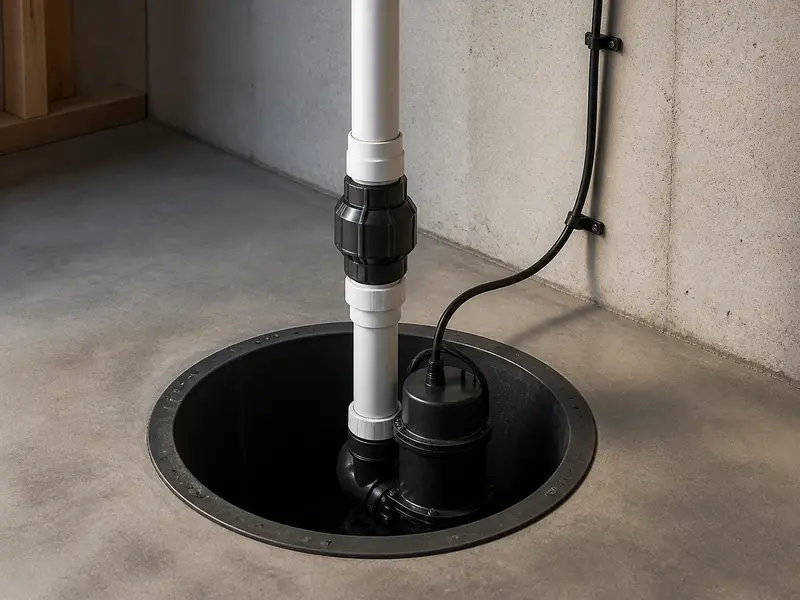
A sump pump quietly protects a finished basement, mechanical equipment, and stored belongings from seasonal groundwater — until the day it stops, the rain keeps falling, and water starts creeping across the floor. If you are reading this because your pump is failing, your basement is wet, or you are sizing a backup before the next storm, this page explains what a sump pump actually does, why it fails, how a professional figures out which fix is right, and what to ask before hiring anyone to work on yours in Montgomery County. It does not recommend a specific contractor or quote a price.
Plain-Language Overview
A sump pump sits in a pit (the “sump”) at the lowest point of a basement or crawl space. Groundwater that collects around the foundation drains into that pit. As the water level rises, a float switch turns the pump on, and the pump pushes the water out through a discharge pipe to a point away from the house [1][2][3]. A check valve on the discharge pipe keeps that discharged water from flowing back down into the pit, which would otherwise force the pump to cycle on and off repeatedly [2][9].
The pump handles groundwater — not sewage. It does not by itself prevent a sanitary-sewer backup, and it does not keep water from ever entering the basement. It works best as one layer in a broader system that includes grading, gutters, downspouts, and foundation drainage [8][2].
Because sump pumps rely on electrical power, they cannot work during a power outage. For that reason, most homeowners who take basement flooding seriously also consider a battery-powered or water-powered backup pump [2][6]. Water-powered backups use municipal water pressure to create suction and are not an option on a private well [5].
When Homeowners Usually Seek Help
Sump-pump trouble tends to cluster around a few situations:
- The first big storm of the season. A pump that has not run in months is suddenly on duty — and either works or doesn’t.
- An older pump that has never been tested. Equipment that was fine last spring may have corroded, clogged, or worn out over a quiet winter.
- Power outages during heavy rain. The most common cause of basement flooding from a “good” sump pump that simply never had a chance to run.
- Visible seepage or standing water on the basement floor, with no clear cause.
- Planning a finished basement, where reliability needs to be locked in before the cost of damage gets bigger.
Common Signs and What Usually Causes Them
A symptom is not a diagnosis, but the pattern is usually a strong clue.
- Pump never runs. Could be a stuck float switch, a power or circuit issue, or a pump that has simply failed.
- Pump runs constantly or short-cycles. Often a failed or missing check valve letting water fall back into the pit, or a float that cannot settle into its “off” position.
- Pump hums but no water comes out. Typically a clogged inlet screen, a jammed impeller, or a frozen or blocked discharge line.
- Pump trips the breaker or GFCI. Often a failing motor drawing too much current, water intrusion into the pump housing, or a ground-fault issue.
- Grinding, rattling, or unusually loud humming. Usually debris in the impeller or a worn bearing.
- Water pooling near the foundation outside. The discharge line is too short, disconnected, or draining back toward the house.
- Frozen discharge line in winter. Water in the pipe has frozen and blocked flow; the pump may keep running without moving water.
- Aging equipment. Sump pumps are wear items; FEMA and other public-safety sources suggest assessing replacement around 10 years of age, though the manufacturer’s recommendation for the specific model should also be checked [1][2].
How Professionals Diagnose
A good diagnostic visit is short, methodical, and grounded in what the pump is doing in front of the technician. Expect the pro to:
- Confirm power and circuit status. Breaker position, GFCI reset, cord condition, and outlet voltage.
- Lift the float by hand to confirm the switch moves freely and the pump responds.
- Inspect the pit for debris, and the inlet screen for sediment or sludge.
- Test the pump by pouring water into the pit and watching whether the float rises, the pump activates, and water actually discharges outside.
- Check the check valve for proper operation — is water flowing back into the pit when the pump shuts off?
- Walk the discharge line outside to confirm it is clear, sloped away from the foundation, and discharging somewhere appropriate (not onto a neighbor’s property or back toward the house).
- For backup systems, test the battery voltage and unplug the primary to confirm the backup actually engages.
A technician who jumps straight to “you need a new pump” without doing any of the above is selling, not diagnosing.
Service and Repair Paths
The right fix depends on the actual cause. Common professional paths include:
- Float-switch service or replacement — freeing a stuck float or replacing a failed switch.
- Pit cleaning and inlet-screen service — clearing debris that is choking flow.
- Check-valve replacement — installing or replacing the valve that prevents backflow into the pit.
- Impeller or pump replacement — replacing the rotating element, or the whole pump when rebuilding is not worth it.
- Discharge-line repair — clearing clogs, fixing slope, extending the line away from the foundation, or rerouting to prevent freezing.
- Backup system installation — adding a battery-powered backup, a water-powered backup (where municipal water is available), or a combination unit.
- Full system installation — cutting a new pit, setting a basin, installing a pump, check valve, and discharge piping for a home that has never had a sump.
A pump that hums but doesn’t pump is rarely “dead” — usually it is clogged. A pump that short-cycles is rarely undersized — usually the check valve is letting water fall back. Good diagnostics save the homeowner money and the contractor a callback.
What Affects Scope
Costs and timelines for sump-pump projects vary widely by home and market. Rather than guess, it helps to know what actually drives the scope:
- Whether a pit already exists. Installing a new sump means cutting the basement floor, excavating, and setting a basin — significantly more involved than swapping out an old pump.
- Pump type and capacity. Submersible vs. pedestal, horsepower, and gallons-per-hour rating all affect equipment choice.
- Backup type. Battery-powered is the most common. Water-powered offers essentially unlimited run time but requires municipal water pressure, is not available on well water, and uses roughly one gallon of municipal water for every two gallons of sump water pumped [5].
- Electrical work. Under the 2020 National Electrical Code, sump pumps rated 150 volts or less to ground and 60 amperes or less require Class A GFCI protection [7]. A dedicated circuit and proper GFCI may be required, which can mean a licensed electrician on the job. The locally adopted NEC edition — not the 2020 edition on its own — is what governs your project, so confirm it.
- Discharge routing. How far and how steeply the water must travel, whether the line must be buried, and whether freezing in winter is a concern.
- Water volume. Homes with a high water table or heavy inflow may need a higher-capacity pump or a second pump.
- Access and finish work. Finished basements and tight pits complicate access and add repair scope after the work is done.
This page makes no cost, savings, or timeline promises. Anything a contractor quotes should be in writing, after they have actually looked at the pit.
Questions to Ask a Contractor
Before signing anything, ask:
- Are you registered as a Pennsylvania Home Improvement Contractor (HIC) with the PA Office of Attorney General, and what is your HIC number? (An HIC registration is a consumer-protection registration — it is not the same thing as a plumbing license.)
- Does this work require a permit or inspection in my specific municipality, and who pulls it?
- Is this a repair or a replacement, and what is the specific cause you found?
- What capacity pump do I need for my home’s water volume, and why?
- Do you recommend a battery backup, a water-powered backup, or a combination, and what are the trade-offs for my situation?
- Will the electrical work require a dedicated circuit or GFCI, and will a licensed electrician be involved?
- Where will the discharge water go, and how will you keep it from draining back toward the foundation or freezing in winter?
- What is included — and what is excluded — in your quote (hauling away the old pump, concrete or finish repair after a new pit, electrical permit fees)?
- What warranty do you provide on the pump and on the workmanship?
- Can you provide proof of insurance and a written contract?
A contractor who answers these directly is much easier to work with than one who bristles at them.
If you already know you need this service, you can compare published sump-pump listings in the directory.
Maintenance and Prevention
Sump pumps are not “set and forget,” but they don’t need constant attention either. FEMA’s public guidance recommends an annual assessment and lists the core steps [1]:
- Test the pump annually by pouring a bucket of water into the pit and confirming the pump activates and discharges.
- Clean the inlet screen more than once a year — some sources suggest every few months in active seasons.
- Inspect the check valve to confirm it is present and functioning.
- Walk the discharge line outside to confirm it is clear, sloped, and discharging away from the foundation (not onto a sidewalk, street, or neighbor’s yard).
- Replace the pump around the 10-year mark, or sooner if the manufacturer’s recommendation is shorter [1][2].
- Periodically test the backup by unplugging the primary (where safe to do so) and confirming the backup engages.
- Consider a water alarm in the pit for early warning of pump failure or excessive inflow.
The honest limit: no schedule of maintenance eliminates the need for eventual replacement. Sump pumps are wear items with a finite service life, and heavy storms shorten that life.
Safety Boundaries
A sump pump is an electrical device sitting in water. That combination deserves real respect.
- Before any service, disconnect power at the breaker and unplug the pump.
- Never touch electrical equipment that is wet or that you are standing in water around. If it is safe to do so, turn off electricity to the affected area first.
- Do not bypass or remove GFCI protection on a sump-pump circuit. The 2020 NEC requires Class A GFCI protection for sump pumps rated 150V or less to ground and 60A or less [7]. The locally adopted edition in your municipality is what actually governs your project — confirm it.
- Do not wade into floodwater. It can be contaminated and may be electrically charged by downed or underground lines.
- A sump pump handles groundwater, not sewage. Sewage ejector and backflow-prevention work involves different equipment and different hazards and is a job for licensed professionals.
- No DIY step-by-step is provided here for the electrical, concrete, or in-wall plumbing work involved in a sump-pump install or replacement. The diagnostics above describe what a professional does, not a homeowner how-to.
Montgomery County Considerations
A few local notes that matter for Montgomery County homeowners:
- Permits and inspections. Montgomery County itself does not issue standard building permits; under Pennsylvania’s Uniform Construction Code, individual townships and boroughs administer and enforce the code. Whether a sump-pump installation or replacement requires a permit or inspection has to be confirmed with the specific municipality — do not assume either way.
- Local plumbing licensure. Pennsylvania has no statewide plumber’s license. Whether a given Montgomery County municipality requires local plumbing licensure or certification in addition to the state HIC registration varies by jurisdiction and must be verified locally.
- Discharge rules. Whether sump water may be discharged into the sanitary sewer, onto a sidewalk or street, or into the storm sewer is set locally. General best practice is to discharge to a lawn or garden area several feet from the foundation, sloping away from the house — but the municipality’s rule controls.
- Electrical code edition. The locally adopted NEC edition (and thus the exact GFCI requirement for a sump pump) must be confirmed before the work is sized.
- County stormwater context. Montgomery County operates a stormwater-management and MS4 program focused on runoff quality and quantity at the watershed level [4]. That program does not establish per-home sump-pump requirements, but it is the county-level context for any larger conversation about basement flooding and groundwater.
The honest answer to “do I need a permit?” is “ask your municipality.” The honest answer to “is this contractor allowed to do this work here?” is the same.
Sources
- FEMA — Maintain your Sump Pump — https://www.fema.gov/node/356171
- Government of Canada — Sump pumps — https://www.canada.ca/en/services/policing/emergencies/preparedness/get-prepared/hazards-emergencies/floods/flood-risk/prevent-flood-damage/sump-pumps.html
- Zoeller Pump Company — Preventing Basement Flooding Through Strategic Sump Pump Placement — https://zoellerpumps.com/2025/01/08/prevent-basement-flooding-strategic-pump-placement
- Montgomery County, PA — Flood Mitigation, Stormwater Management, & MS4 Program — https://www.montgomerycountypa.gov/departments/planning-commission/planning-topic/programs-initiatives/flood-mitigation-stormwater-management-ms4-program
- Consumer Reports — Sump Pump Backup System Buying Guide — https://www.consumerreports.org/home-garden/sump-pumps/buying-guide
- Ready.gov (FEMA/DHS) — Floods — https://www.ready.gov/floods
- Leviton (reprinting NFPA 70, 2020 NEC) — 422.5(A) GFCI Requirements for Appliances — https://captaincode2020.leviton.com/node/261
- Roto-Rooter — How Does a Sump Pump Work? — https://www.rotorooter.com/blog/sump-pumps/the-purpose-of-a-sump-pump
- Zoeller at Home — Why Are Sump Pump Check Valves Important? — https://zoellerathome.com/2023/09/29/importance-sump-pump-check-valves
- This Old House — How to Install a Sump Pump — https://www.thisoldhouse.com/basements/how-to-install-a-sump-pump
Related video
Simple Sump Pump Maintenance
A safety-first demonstration shows basic inspection, inlet, check-valve, and test-cycle concepts for an existing sump pump.
Video: Simple Sump Pump Maintenance — Central Insurance.
Context and limits: The publisher is an insurance company. Electrical, drainage, excavation, or replacement work belongs with qualified professionals.